Vietnam's food trade industry is one of the most dynamic sectors in the country. Fueled by an expanding middle class, rising disposable incomes, and shifting consumer preferences, the increasing demand for high-quality food products is undeniable. From bustling markets in Ho Chi Minh City to modern supermarkets in other major cities, the opportunity for both […]
Vietnam's food trade industry is one of the most dynamic sectors in the country. Fueled by an expanding middle class, rising disposable incomes, and shifting consumer preferences, the increasing demand for high-quality food products is undeniable. From bustling markets in Ho Chi Minh City to modern supermarkets in other major cities, the opportunity for both […]
Vietnam’s aviation market has seen a robust development in the recent decade. This development can be attributed to Vietnam’s strong economic growth, a growing tourism industry and an increasing middle class population. Additionally, low-cost airlines have emerged in recent years to make air travel more affordable.
Due to the quick recovery after the pandemic, this market is now attracting foreign newcomers to do business again. In today’s article, Viettonkin will provide you with up-to-date information related to setting up an air transport company in Vietnam.
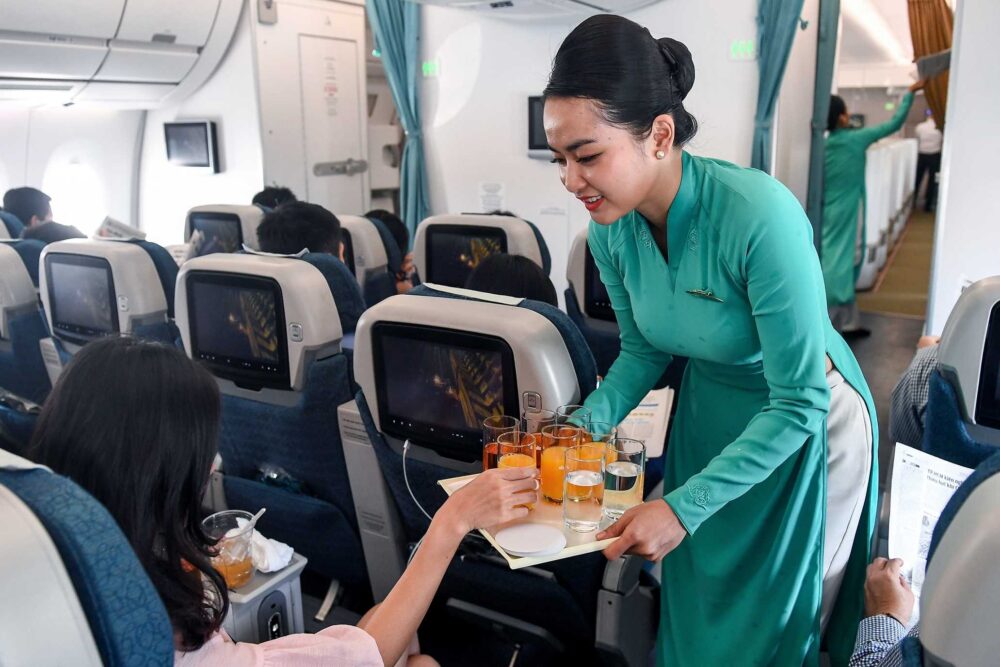
Vietnam’s aviation is a promising market in recent years
Photo by Vietnam Airlines
The aviation industry has garnered much interest among investors during the past 5 years. Sectors that have drawn the most attention are airport construction, airlines, and aviation services. In 2019, according to the International Air Transport Association (IATA), Vietnam was the world’s seventh fastest-growing aviation market.
At present, Vietnam has 22 airports, including 12 international airports and 10 domestic one. Vietnam has made investing in airport infrastructure a top priority. The Government set a goal to construct 6 new airports and upgrade most tourism hub airports by 2030, with a total investment of approximately $17.68 billion.
This market was on the rise and the growth attracted numerous start-up airlines. Several foreign new carriers were set up. However, the Covid-19 pandemic forced the aviation industry to freeze in the past 2 years.
After the pandemic, the aviation market in Vietnam is now vibrant again. Vietnam is the world’s fastest recovering domestic aviation market, according to IATA. In the first 6 months of 2022, the market saw a growth rate of 123% compared to the same period of 2019. Experts said this year the total number of passengers would likely reach 87.8 million, up 190% compared to 2021.
Conditions to set up an air transport business in Vietnam
In general, air transportation means the transportation of passengers, baggage, cargo, parcels and mail by air. According to Law on Investment 2014, air transport business is a conditional business, so that enterprises must have a license when setting up their business.
The Law on Civil Aviation of Vietnam 2006 (amended in 2014) stipulates conditions for granting air transportation business license, as followed:
Enterprise has a Business Registration Certificate indicating that its main scope of business is air transportation;
It has a plan of acquiring aircraft;
It has an appropriate organizational structure and personnel who are suitably certified to ensure the operation of aircraft and air transportation business;
It has sufficient capital as specified by the Government;
It has a business plan and strategy for the development of air transport products in line with the market’s demands and the civil aviation industry planning
It has a principal office and place of business in Viet Nam.
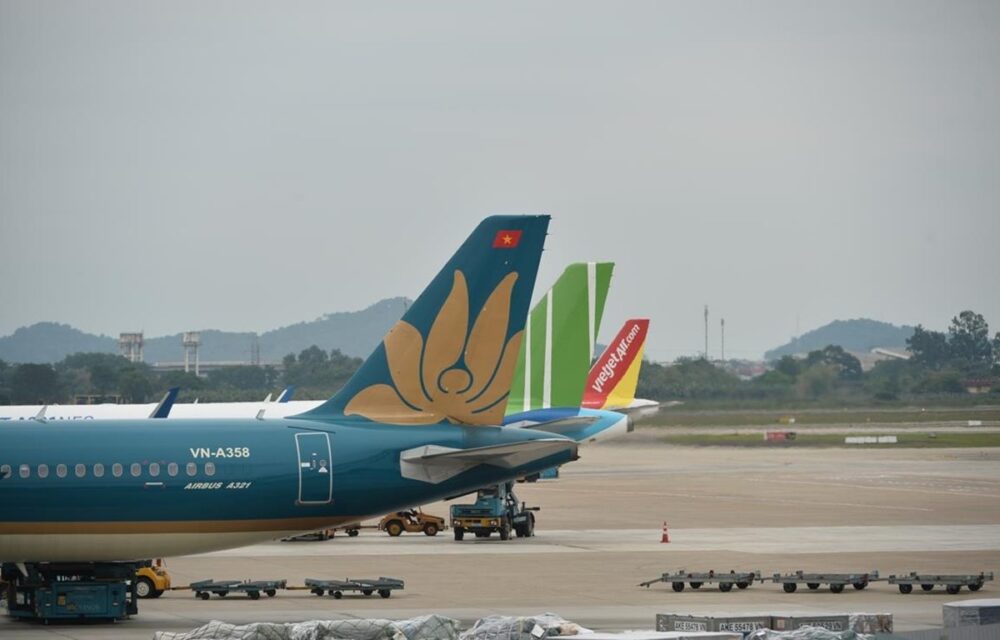
Photo by VietnamPlus
In addition to these above conditions, a foreign-invested enterprise shall be granted with air transport business permission if it meets the following conditions:
The ratio of foreign-invested capital is in conformity with the stipulations by the Government;
Legal representative of the foreign-invested enterprise shall be a Vietnamese national and foreign nationals shall not account for more than one third of the management machinery.
The air transportation business permission shall be granted by the Minister of Transport upon the approval of the Prime Minister.
An enterprise applying for air transportation business permission shall pay fees.
The Government shall specify specific conditions, procedures, and formalities for granting the air transportation business permission.
The most noteworthy point is the conditions regarding the ratio of capital to start an air transport business in Vietnam. To attract more foreign newcomers, the Government has amended the regulation several times in recent years.
Relaxed requirements regarding charter capital
The latest regulation is Decree 89/2019/ND-CP coming into force on January 1, 2020. By issuing Decree 89, the Government amended and supplemented some articles of Decree 92 in 2016 on conditional business lines or activities in the civil aviation industry. They aim to create favorable conditions for enterprises to set up airlines and attract foreign investment.
Here are the key amendments that can benefit enterprises:
Decree 92/2016/ND-CP
Decree No.89/2019/ND-CP (new)
Airlines with a maximum of 10 aircrafts must have a charter capital of at least VND 700 billion to operate international flights and VND 300 billion for enterprises only in domestic air transportation. Airlines with 11-30 aircrafts must have at least VND 1 trillion to provide international services or at least VND 600 billion to operate domestic flights. With 30 aircrafts, the amount is VND 1.3 trillion and VND 700 billion, respectively.
Airline transport business exploiting 10 aircrafts must have a charter capital of at least VND 300 billion ($13 million).
Airlines with 11-30 aircrafts must have at least VND 600 billion ($26.1 million).
Airlines with more than 30 aircrafts must have at least VND 700 billion ($30.43 million).
It can be seen that the Government has significantly reduced the amount of charter capital and eliminated the capital gap between exploiting international and domestic flights.
However, foreign-capital-invested air transport businesses must satisfy 3 further conditions. First, the foreign ownership must not exceed 34% of the charter capital, which is higher than that of the old regulation (30%). Second, foreign enterprises must have at least one Vietnamese individual or a Vietnamese legal entity holding the largest portion of charter capital. Third, in case the Vietnamese legal entity has grown owned capital, the foreign capital contribution shall not exceed 49% of the charter capital of the Vietnamese.
Moreover, the Government eliminates the condition that two years after an airline obtains an air transport license, ownership of the company must be transferred to foreign investors.
Requirement on the age limit for used aircraft imported in Vietnam is another important point that foreign enterprises should pay attention to. A used passenger transport aircraft must be older than 10 years, measured from the date of release to the date of importation in Vietnam, or not exceed 20 years from the release date to the time of expiration of the hire contract. The age of used helicopters must not exceed 25 years.
Though Vietnam’s aviation market can produce lucrative opportunities, the regulatory complexity can pose a big challenge to foreign enterprises hoping to start business in this market. With insightful knowledge into the aviation market and its related regulatory framework, Viettonkin can provide valuable guidelines for our partners and help you concentrate your power on your business. Let’s work together!
Entering Vietnam's Banking Market: Get Your Essential 2025 eBook
Vietnam's dynamic banking sector is a top destination for foreign investment. To succeed, you need a deep understanding of the local landscape, from new regulations to market entry models.
Our eBook, "ESTABLISHING FOREIGN BANK PRESENCE IN VIETNAM" gives you the crucial insights you need, including:
2024–2025 Sector Overview: Key economic and banking industry analysis.
Step-by-Step Entry Guidance: A deep dive into all primary market entry modes.
The Latest Legal Updates: Critical regulatory changes taking effect in 2025.
Smart Investment Strategies: Insights on M&A, strategic equity, and Fintech.
Download now for the expert knowledge to invest with confidence.
Entering Vietnam's Banking Market: Get Your Essential 2025 eBook
Vietnam's dynamic banking sector is a top destination for foreign investment. To succeed, you need a deep understanding of the local landscape, from new regulations to market entry models.
Our eBook, "ESTABLISHING FOREIGN BANK PRESENCE IN VIETNAM" gives you the crucial insights you need, including:
2024–2025 Sector Overview: Key economic and banking industry analysis.
Step-by-Step Entry Guidance: A deep dive into all primary market entry modes.
The Latest Legal Updates: Critical regulatory changes taking effect in 2025.
Smart Investment Strategies: Insights on M&A, strategic equity, and Fintech.
Download now for the expert knowledge to invest with confidence.
Founded in 2009, Viettonkin Consulting is a multi-disciplinary group of consulting firms headquartered in Hanoi, Vietnam with offices in Ho Chi Minh City, Jakarta, Bangkok, Singapore, and Hong Kong and a strong presence through strategic alliances throughout Southeast Asia. Our firm’s guiding mission is aimed towards facilitating intra-ASEAN investments and connecting investors in Southeast Asia with the rest of the world, thus promoting international business relationships and strengthening inter-nation connections.





 English