Vietnam's food trade industry is one of the most dynamic sectors in the country. Fueled by an expanding middle class, rising disposable incomes, and shifting consumer preferences, the increasing demand for high-quality food products is undeniable. From bustling markets in Ho Chi Minh City to modern supermarkets in other major cities, the opportunity for both […]
Vietnam's food trade industry is one of the most dynamic sectors in the country. Fueled by an expanding middle class, rising disposable incomes, and shifting consumer preferences, the increasing demand for high-quality food products is undeniable. From bustling markets in Ho Chi Minh City to modern supermarkets in other major cities, the opportunity for both […]
With 9.265 valid projects, Korean FDI remains one of the largest foreign investment in Vietnam. Total registered capital accumulated by $78.6 billion by the end of March 2022, almost doubled that of 2015 ($43.7 billion) when the Vietnam - Korea Free Trade Agreement (VKFTA) first started. Evidently, Vietnam is still Korea's favorite investment destination despite the spread of COVID-19.
Korean FDI dominating fields in the past and now
In Vietnam, Korean companies mainly focus on investing in specific fields such as the processing and manufacturing industry, electronics, technology, logistics, and construction. In 2017 and earlier, manufacturing was the leading industry with the highest balance of FDI capital from Korea, with a percentage of over 70%. Yet, the share of investment in the manufacturing industry gradually fell to 62% in 2018, 57% in 2019, and 61% in 2020.
On the other hand, sectors like construction, real estate, distribution and retail, finance, and insurance have been increasingly attracting FDI from South Korea in recent years. Despite dropping below 4% in 2019, the proportion of Korean investors’ investment in construction and real estate has increased to more than 10% in 2020, reaching approximately 11% in the first half of 2021.
Collaboration on a strategic level between Korea and Vietnam
With all the mentioned efforts, Vietnam and Korea are planning to elevate to a strategic partnership. To exemplify, Vietnam’s measures in preventing COVID 19 have been bolstered by the Korean government and enterprises operating in Vietnam. Vietnam has also removed obstacles and created a favorable environment for Korean firms in the supply chain. Particularly, during the visit of the President of the National Assembly Vuong Dinh Hue to Korea, the two governments signed a bilateral agreement on social insurance, ensuring better conditions for Vietnamese workers working abroad in Korea and vice versa. The Vietnamese National Assembly has also implemented laws to secure new development requirements and support new sectors of the digital economy.
Moreover, Mr. Vuong Dinh Hue affirmed that sustainability and digitization are major trends globally as well as in Vietnam. Regarding investment in clean energy, Hue also stated that the Assembly will allow private investors to invest in the field of conditional power transmission, welcoming Hanwha Group to invest in this sector. In the field of finance, Mr. President suggests that Korean banks and financial groups increase their investment in Vietnam to develop the banking services in this country. To support Korean banks, the Vietnamese National Assembly will amend the Securities Law to form non-voting shares.
Vietnamese Government policies in attracting Korean FDI
Hanoi has been creating great incentives for Korean investors interested in the Vietnamese economy. In 2021, Vietnam and South Korea revised their Agreement on Double Taxation Avoidance, contributing to the improvement of the tax administration. Likewise, in 2022, the two countries are continuing to amend their cooperation and mutual administrative assistance agreement in the customs field, forming a faster and more efficient customs clearance process.
On top of that, in June 2021, the Government issued Decision No. 29/2021/QD-TTG on special investment incentives. According to this amendment, aside from the corporate income tax incentives, investment projects that meet certain conditions are also exempted from land and water surface rent for 18-20 years. Land and water surface costs are furtherly reduced by 55-75% throughout the project lifecycle. Correspondingly, large investors, namely Samsung and LG, are also enjoying investment stimuli at this level.
In addition, Decision 29/2021/QD-TTG has set forth transparent and clear bars on the technology transfer level, R&D investment, added value increase, and enterprises’ participation in the chain. Classification of firms into different levels with specific criteria was also applied. Samsung has benefited considerably from this decision in its $220 million R&D center construction in Hanoi.
Overall, the Vietnamese government’s orientation of including high technology and R&D in FDI investment attraction has been decidedly suitable for Korea’s demand to expand electronics and semiconductor sections.
Upcoming trends of Korean FDI in Vietnam
The year 2022 is the 30th anniversary of diplomatic cooperation between Vietnam and Korea Therefore, meetings, exchanges, and investment promotion activities have been held, expecting to open new investment opportunities for over 200 Korean businesses in Vietnam. Provinces like Thanh Hoa, Hai Phong, and Nam Dinh are also opening up considerable chances for Korean ventures, attracting numerous investors.
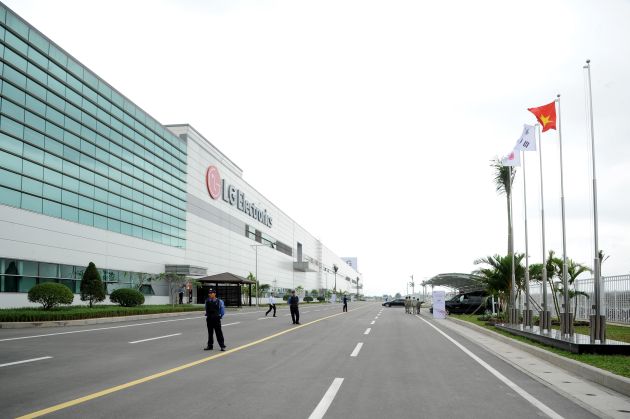
These efforts have been proved to be effective as Hai Phong province, for example, has managed to attract 171 FDI projects from Korea with a total registered capital of about $9.56 billion, accounting for 36.6% of total FDI invested in the city. The industrial and economic zone particularly attracts 102 projects with a total capital of $8.5 billion. For instance, LG Group has invested $7.24 billion in Trang Due Industrial Zone, providing jobs for nearly 25,000 workers, bringing an estimated revenue of $14.5 billion in 2021, and paying more than $95 billion to the state budget.
LC Electronics in Hai Phong, Vietnam
Le Trung Kien, the manager of the Hai Phong Economic Zone, stated that the city has built 13 industrial parks with a total area of 5,694 hectares. All industrial parks have modern infrastructure and are synchronously connected to the national transportation system via sea, railway, road, air, and inland waterways. According to the plan, by 2025, Hai Phong will open 15 more industrial parks with a total area of about 6,200 hectares while committing to improving the business investment environment. Resources on infrastructure development in terms of traffic, urban areas, and tourism - services will additionally be a focus.
In conclusion, thanks to the supportive policies from the two governments, Korean investment in Vietnam has been experiencing a blossoming trend. Positive impacts on the Vietnamese economy through economic growth promotion, new job opportunities, and technology transfer were also brought about. However, the growth in Korean investment inflows also carries setbacks such as site clearance issues and management and use of labor problems. Hence, Korean investors should research and prepare carefully before entering into the Vietnamese dynamic market.
With more than a decade of experience, Viettonkin believes that our professional and competent team of experts can help you with your decision-making process, joint venture and local enterprises promotion, and looking for partners to build the supply chain and partnership network in Vietnam. If you are interested in learning more about opportunities and challenges when investing in a developing economy like Vietnam, please contact our Vietonkin consultant team via email or contact page.
Before the outbreak of Covid 19 pandemic
Before the appearance of Covid-19, Russia ranked 26th largest foreign investor out of 126 FDI countries in Vietnam, with 123 projects up to 933 million USD. Most Russian investment projects focused on the oil and gas, mining and real estate industries. However, the investment inflow from Russia into Vietnam was trickling and limited as the total registered capital even reached below 1 billion USD for overall 123 projects. This means the average size of each project was only slightly above ten million USD.
In 2019, the number of registered projects amounted to 137, standing at 23 out of 135 FDI countries in Vietnam, with its primary industries remaining oil and gas and mining. The total registered capital marginally increased to 943 million USD. Aside from oil and gas, a modest number of Russian investors were interested in weapons and several civilian fields. Notably, ROSTEC is one of Vietnam's most prominent and oldest Russian investors in military engineering and technology. In recent years, the company has been expanding its investment in other civilian sectors, namely, healthcare, automotive, and agriculture technology. According to ROSTER, their share of civilian products in the total revenue will exceed 50% by 2025 in Vietnam.
During the pandemic
Amid the Covid-19 pandemic, the oil and gas industry worldwide, including Vietnam, was severely affected. The average crude oil price in March 2020 decreased by 20 USD compared to February of 2020. Meanwhile, the average oil price in the first quarter of 2020 declined by 9.1 USD/ barrel compared to the same period in 2019. As a result, the slump in oil prices devastatingly affected the revenue of oil manufacturers worldwide.
However, in Vietnam, the FDI oil companies from Russia remained stable. In particular, the revenue from oil and gas manufacturing of Vietsovpetro still reached over 1,684 billion USD, over 149% of the yearly plan. Specifically, the state budget revenue reached 922 million USD, up 317 million USD compared to the assigned goal.
Besides, Russia's largest independent gas producer-Novatek-has partnered with Ninh Thuan province in Vietnam to develop an integrated NLG (low tonnage liquefied natural gas) energy production project. Further, “giant” Russian oil and gas corporations, namely Gazprom and Rosneft, are expected to participate in diverse projects in Vietnam by 2030.
In the “new normal” and the Russia-Ukraine conflict
As of February 2022, the total registered capital of direct investment from Russian investors in Vietnam reached 953 million USD with 151 projects, securing its 24th rank over 140 FDI countries. Most of the projects have been directed toward the energy industry, in which oil and gas exploration and production is an essential field in investment cooperation between Vietnam and Russia. Under Vietnamese current economic growth, the demand for energy, especially coal, oil and gas, has been burgeoning.
Yet, the escalation of tensions between Russia and Ukraine has recently shaken investors, who were concerned about the negative impact of the war on the global economy. In addition, on February 27, the US, the UK, Canada and the EU announced blocking the connection of several Russian banks from the international payment system - SWIFT. This decision will wobble the investment in Russia in other countries, including Vietnam. VnDirect emphasized, "We think that sanctions, including blocking the SWIFT connection of the Russian financial system, will affect Russian investment projects in Vietnam, mostly power and oil and gas projects."
What opportunities remain for Russian investors in Vietnam?
At the Vietnam - Russia Business Forum, Vietnamese President Nguyen Xuan Phuc highlighted the potential cooperation between the two countries. The President considered the comprehensive strategic partnership between Vietnam and Russia as a solid foundation for economic growth. Yet, the turnover from both countries was still low, merely reaching over 5 billion USD. Meanwhile, the number of investment projects was limited to only over 150, valued at 150 billion USD.
State President Phuc assured a stable and favorable political, economic and social context in Vietnam for attracting more Russian investors. The Vietnamese government would continue the training of high-quality human resources and developing infrastructure for other investment corporations. He firmly affirmed that Vietnam would create transparent and predictable policies.
President Nguyen Xuan Phuc also expressed, “We consider Russian companies in Vietnam not only as foreign investors but also as dear friends. You are an essential element that contributes to the traditional friendship between the two countries.” Vietnam further encourages Russian investors to take strong steps toward investment in other industries besides the oil and gas industry.
No better time than now is for Russian companies to enter Vietnam. With diverse preferential policies from the Vietnamese government and the close long-lasting relationship between Russia and Vietnam, Russian investors will harvest tremendous benefits if they seize the opportunities. Let leading experts in the industry help you! Viettonkin is proud to have a professional team of well-performed and top-notch consultants who can assist you through the process of starting up a business in Vietnam.
The leading real estate group Cheung Kong Group of Mr Li Ka-shing and Orix Group of Japan, through their local partner Van Thinh Phat Group of Vietnam, had a meeting with Mr Phan Van Mai - Ho Chi Minh City President to discuss investment in the city.
Notably, the participants in this conference are all reputable parties. Among them, Orix Group is the ‘giant’ non-banking financial group in Japan, its financial business covers 27 countries around the world. Van Thinh Phat Group is also a famous local corporation in Vietnam. The three super-complexes with the local government have shown that Mr Li Ka-shing seems to want to do something big here.
Cheung Kong Group has committed to investing in high-end real estate projects in Ho Chi Minh City, including office buildings, commercial centres, entertainment facilities, and housing businesses. Other large-scale infrastructure projects will also be launched simultaneously, indicating a large amount of money will be invested in these areas soon. This has attracted the attention of the business community. With this meeting, it seems that Mr Ly Ka-shing, after withdrawing from Europe, will choose Vietnam as his next stop.
On April 30, Albert Song, a researcher at Tianjun, a politics and economics think tank, told The Epoch Times: “Li Ka-shing hastily moved his assets again and keenly explored Vietnam as the new investment territory because Vietnam’s economy is rapidly rising. Even in 2020, the worst year of the pandemic, its GDP growth rate still exceeds China’s and ranks among the top in the world.”
Song has 27 years of experience in China’s financial industry.
Amid the COVID-19 pandemic in 2021, Vietnam’s total import and export volume was still close to $670 billion; this increased nearly 23 per cent year on year, a record high. At the same time, Vietnam recorded a trade surplus for a sixth consecutive year of over $4 billion.
The Vietnamese stock market set a new record last year, with the Vietnam Index (VN-Index) reaching a trading record of 1,500.8 points on Nov. 25, up nearly 36 per cent from the end of 2020.
“Foreign trade is booming, domestic demand is boosted, asset prices are rising, and Vietnam has shown amazing economic dynamism,” Song said.
Vietnam’s exports in the first quarter of 2022 increased by 15.9 per cent year on year, while China’s Shenzhen exports fell by 14 per cent in the first quarter of this year. Shenzhen has been the city with the highest export value in China for 29 consecutive years.
Song believes that Vietnam’s implementation of “coexistence with the virus” has strengthened its position in the global industrial chain.
“For Vietnam’s economy, which relies on foreign trade, the rapid recovery of import and export trade has directly boosted the rapid recovery of Vietnam’s economy. Since this year, many Japanese, Korean, European, and American technology companies have transferred orders to Southeast Asia.”
Regarding China’s position in the global industrial chain, Song believes that “the risk of decoupling between China and the global industrial chain is increasing, and Europe and the United States are showing strong interest in Vietnam and other Southeast Asian countries, and Vietnam is becoming a new supply chain centre.”
“The total trade volume for the year is expected to exceed the $800 billion mark. Many factories in Vietnam are fully booked with orders this year, including many orders voluntarily transferred to Vietnam by Chinese companies. The total trade volume for the year is expected to exceed the $800 billion mark.”
In general, Mr Li Ka-shing's investments so far are considered very trendy and always create trends. Not only Mr Li Ka-shing, but international investors from different parts of the world also recognize Vietnam as a strategic investment plan. This means that Vietnam is considered highly a favourable environment for foreign investors, especially in real-estate businesses thanks to its potential development. The chances are wild open with preferential policies for further investment. So, it is time for investors to take a decisive move and harvest the “fruit” in Vietnam. With a leading role in professional and in-depth knowledge in the industry, Viettonkin will walk you through the complicated process of starting up a business in Vietnam. Contact us for further information.
After the unprecedented COVID-19 shock, the aviation industry in Vietnam is in the stage of revival. In particular, the industry grew by 441% in the first quarter of 2022, compared to the same period of 2021, while the number of domestic passengers decreased significantly (Civil Aviation Authority of Vietnam - CAAV, 2022). As of March 2022, the international aviation market has 23 foreign and domestic airlines (including Vietnam Airlines, Vietjet Air, and Bamboo Airways) operating to and from 20 countries and territories. Yet, in comparison to the pre-pandemic period, there are currently 8 countries that have not reopened regular flights to and from Vietnam, including Brunei, India, Indonesia, Myanmar, Macau, Finland, Italy, and Switzerland.
In response to this situation, Dr. Bui Doan Ne - Vice President and General Secretary of the Vietnam Aviation Business Association (VABA) - stated the phenomenal recovery of the aviation sector as a result of the accelerated vaccination plans by the government and localities. Management strategies for Covid-19 and solutions to support economic rebound are critical factors in recuperating the Vietnamese aviation industry to its pre-epidemic growth rate. Dr. Ne also forecasted that with the growth of the airline industry in the upcoming time, Vietnam's economic growth in 2022 will potentially reach 15-20% compared with the one in 2021. What's more, if the pandemic situation is fully contained and the economy is re-opened, the aviation sector will recover sustainably in the year 2022.
Supporting policies from the Vietnamese Government
Aware of the Covid 19 pandemic’s adverse effect on the global economy, the MOT has decided to reduce the price of take-off and landing services by 50 percent and remove charges for many aviation services, along with cutting down jet fuel fees and relaxing capital market conditions to support the airline industry.
According to Circular 04/2021/TT-NHNN, the State Bank of Vietnam has refinanced credit institutions that offered loans to Vietnam Airlines and reschedule the debt payment period, keeping the same debt group, and setting up risk provisions for debts of the Airports Corporations of Vietnam (ACV). In addition, Resolution No. 135/2020/QH14 of Congress also allows the ACV to sell more stocks to increase charter capital. Environmental protection tax imposed on aviation fuel as well as other general taxes and fees is also lowered to support airline businesses. With the recovery in process, along with the government’s incentive and supporting policies, the aviation industry still has plenty of potential for development, especially in infrastructure and cargo transportation.
Upcoming Opportunities
Aviation infrastructure
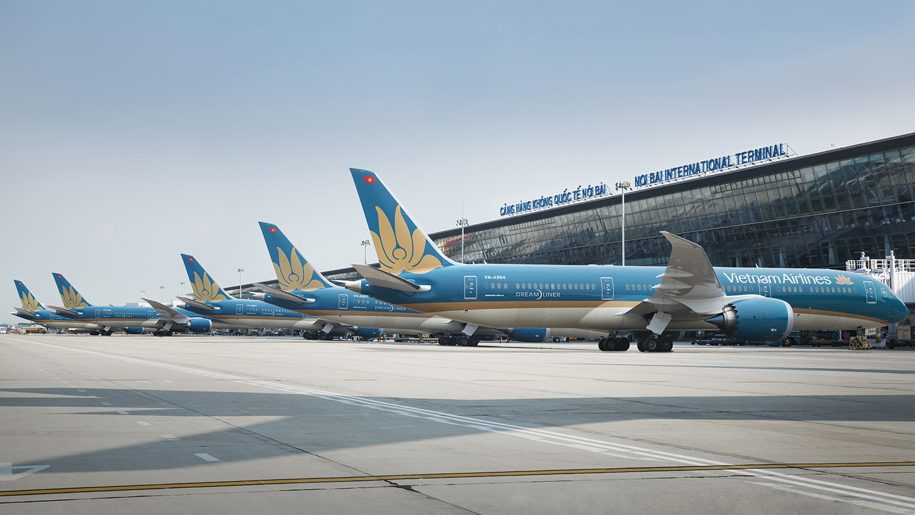
To meet the demand of expected 275.9 million passengers and approximately 4.1 tons of cargo in 2030, the Ministry of Transport (MOT) has prioritized investing in several airports that are of great importance in the Hanoi Capital region and Ho Chi Minh City region like Noi Bai, Tan Son Nhat, and Long Thanh International Airport. The demand for aviation is estimated to spike with 275.9 million passengers and nearly 4.1 tons of cargo by 2030. Thus, the Ministry of Transport (MoF) has prioritized investing in several key airport infrastructures in Hanoi and Ho Chi Minh City namely Noi Bai, Tan Son Nhat, and Long Thanh. Simultaneously, 22 existing airports are being gradually upgraded and effectively operating, of which 6 new airports are under construction and investment. Additionally, authorities in some districts as well as “giant” corporations, notablyVietjet, Vingroup, FLC Group, and Sun Group, have also addressed their interests in investing in airports such as Chu Lai, Cat Bi, Tuy Hoa, Dien Bien, Dong Hoi, Quang Tri, and Van Don.
Noi Bai International Airport
On the other hand, according to Professor Dang Dinh Dao, while some large airports are operating efficiently, many local airports are only operating at one-third of their designed capacity. The total productivity of 22 airports in Vietnam lies at about 75 million passengers per year, comparable to that of a single Changi airport in Singapore. This reality indicates that the aviation sector in Vietnam still has room for improvement and presents potential opportunities. Thus, the ministries and departments are paying more attention to private participation instead of solely state contribution. Particularly, the Prime Minister has recently approved to invest in Quang Tri airport and Sapa airport under PPP, promising to increase the participation of private enterprises in airport infrastructure investment. The Ministry of Transport has also proposed mobilizing public capital resources to invest in the entire airport in the form of PPP. Overall, bright prospects for investment are waiting for the private sector and foreign investors.
Airfreight
As of airfreight, it has been playing an important role in supporting the global trading system, conducting an estimated 35 percent of global trade. According to the CAAV, the approximate number of international passengers by air decreased by 93% in 2021. Meanwhile, freight transport increased dramatically by 21.3 percent compared to 2020, reaching approximately 1.1 million tons of cargo. The upturn in cargo freight can be attributed to Decision No. 318/QD - TTg dated March 4, 2014, in which the Prime Minister plans to develop 8-10 cargo aircraft. This rising trend is maintained steadily, with cargo airlines' gain in the frequency of flights to and from Vietnam. For example, DHL express, an international express delivery service provider, officially opened a new route operated by Kalitta Air between Ho Chi Minh City and the United States last February. DHL Express representative announced that the opening of this new route is to meet the increasing transportation needs for the e-commerce sector between the two countries.
Many commentators are of the view that the growth of e-commerce along with some recent maritime incidents, e.g., the 2021 Suez Canal obstruction, will likely boost the demand for air freight in the future. Additionally, 5 airlines are operating simultaneously in Vietnam, yet the nation still lacks a cargo-specialized airline.
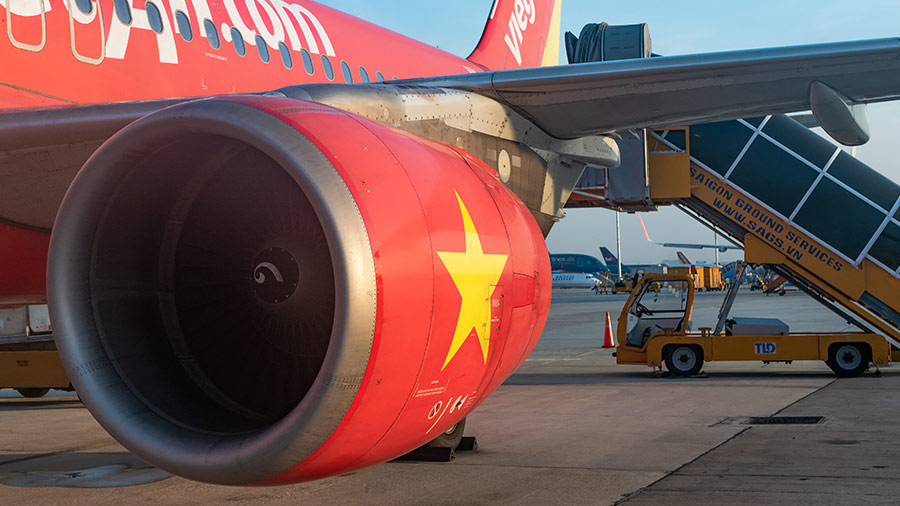
Vietjet Airlines-one of the largest airlines in Vietnam
Seeing this opportunity, IPP - Air Cargo by Mr. Jonathan Hanh Nguyen is in its final preparation stages to become the first Vietnamese airline that provides specialized freight services. It is waiting for the operating license to finish its legal process. The IPP's prompt actions are considered compatible with the country's development orientation and e-commerce trend. Therefore, the MOT has proposed to the Prime Minister to speed up the procedures, granting IPP Air Cargo a business license for air freight transportation. As of now, the IPP has signed a Memorandum of Understanding with the Boeing Company to purchase ten B10 B777 Freighters that are worth 3.5 billion USD. If this deal is completed successfully, IPP Air Cargo will become the cargo airline with the largest capacity in Southeast Asia.
Existing problems
Despite the untapped potential and the government's recovery policies, unexpected global crises are having significant impacts on Vietnam’s aviation industry. Under the impact of the conflict between Russia and Ukraine, the abrupt increase in fuel prices has had a great influence on airlines since fuel costs account for the largest proportion of the operating expenses. Not to mention, some airlines also have to adjust their flight route to ensure safe operation for the crew and customers. Rerouting of flights has significant impacts on costs, leading to higher fuel prices and consequently higher fares, which directly reduce the demand recovery. For example, the Hanoi - Paris route has had to alter its flight path to avoid flying through China and Kazakhstan, making the flight time longer by 2 hours and 5 minutes and increasing the operating cost by 20,000 USD for each flight. To reduce input costs, the flight control department would have to recalculate and reevaluate more optimal alternative routes. The industry is making a great effort to emerge into a ‘new normal'
Conclusion
All things considered, although operational challenges and concerns about the Covid epidemic are still causing difficult times for the aviation industry, Vietnamese airlines are still experiencing a rebound in demand due to their determination to speed up the recovery process and the government's supportive policies. For further insights about the Vietnamese aviation sector's chances and challenges in this critical time, please contact Viettonkin's proficient consultants. With more than 10 years of experience in consulting, our professional team will provide you with thorough analysis and detailed advice to help you navigate from a global perspective.
Vietnam is without exception hard hit by the ongoing COVID-19 epidemic; however, the country is the fastest-growing nation in ASEAN. Despite market uncertainty, Vietnam is strongly recovering post-COVID-19 and relentlessly developing the digital economy (PwC, 2021). In this way, global capital continues to pour into the country, in which investment appetite in Fintech is still strong. Therefore, Fintech in Vietnam has blossomed and granted one-of-a-kind opportunities, yet the difficulties in entering the market remain a barrier for domestic and foreign investors.
Market overview
In ASEAN region, deal activity skyrocketed in the first half of 2021, surpassing the full-year investments of recent years. Funding rebounded from a plunge of 2020, reaching 3.5 billion USD for the first nine months of 2021, more than a three-time increase from 2020 and rank three in ASEAN. This figure set a high record for Fintech funding in ASEAN-6. In particular, Singapore topped Fintech funding numbers in 2021 with 44% of the total amount, while Vietnam accounted for 11%, ranking third after Indonesia with 26%. Although still lagging compared to Singapore and Indonesia, the growth signals of the Fintech market in Vietnam are remarkable.
According to statistics from the State Bank of Vietnam, from 2016 to now, the number of fintech companies participating in providing services in the Vietnamese market has increased by about 4 times. In which, up to 70% of companies are associated with banks. Only 14% companies develop new services and 14% ones are ready to compete with banks.
In addition, 13 mega-rounds with deals worth 100 million USD amounted to 2 billion USD and made up more than half of total Fintech funding in ASEAN in 2021. The average deal size increased from 9 million USD in 2020 to 21 million USD in YTD 2021. The number of funding deals grew by 32% to 167 deals in YTD 2021, with almost half the deals going to Singapore-based FinTech firms. Meanwhile, Indonesia made up a quarter of deals, with Vietnam joint third with 9%. Specifically, Vietnam sharply bounced back in funding, most notably two large deals: 250 million USD into VNPay and 100 million USD into MoMo's Series D fundraising round.
In spite of the Covid-19 pandemic, Vietnam remains a very attractive start-ups hub with more incubators, accelerators, and innovation labs than most other markets in the region. Within two years from 2015 to 2017, compared with 39 start-ups in 2015, the number of new Fintech grew dramatically to 44 companies in 2017, of which 23 belonged to the field of electronic payment. The figure tripled from 44 to 124 companies in the next two years, mainly in the Peer-to-Peer lending (P2P lending) service segment. In YTD 2021, 188 fintech companies were established in Vietnam. The top 4 sub-sectors accounting for 77% of the total included payments, investment tech, cryptocurrencies, alternative lending.
Vietnam is receiving increasing deals, but 93% of the funding pour into payments. This may suggest that investors are more cautious and risk-averse due to the economic concerns from the prolonged pandemic. As such, investors have altered their investing strategy towards more mature FinTechs as they are assumed to be more resilient and stand a higher chance of emerging more substantially from the pandemic. (UOB, 2021)
Potential markets
According to Ms. Le Vy - Co-founder and General Partner of Do Ventures, leading the payment segment in Vietnam are domestic companies, namely VNPay and MoMo, while in the market, there are also regional "big players" participating in this "playground", such as Grab through cooperation with Moca to create a Grabpay e-wallet. However, according to experts, in 2022, the e-wallet market will be fiercely competitive, possibly promoting e-wallet providers to merge into a few top “super apps” in order to dominate the market. In addition, many “super apps” and service providers from other economic sectors (such as e-commerce, retail and financial services) also show interest in this segment.
While payment businesses make up the majority of FinTech firms in Vietnam, alternative lending and crypto firms are catching up. Vietnam ranked second in cryptocurrency adoption rate among 74 surveyed economies, driven by remittance payments (Statista, February 2021). However, bitcoin and other cryptocurrencies are not recognized as legitimate means of payment in Vietnam. Furthermore, the government and policymakers may need to consider policy options to manage cryptocurrency scams while also developing strategies to control cryptocurrencies' legal and illegal uses and their role in cross-border currency flows. The State Bank of Vietnam (SBV) has warned that owning, trading and using cryptocurrencies are risky and not protected by law.
On the other hand, the Insurtech market in Vietnam is driven by the Covid-19 pandemic and the trend of digital transformation. In particular, insurance products that are heavily invested in technology to increase customer access and optimize user experience are gaining attraction in the eyes of investors. Many foreign investors are increasingly interested in the Vietnam Insurtech space, apart from the domestic funds. Currently, the Vietnamese Insurtech market is booming with several start-ups being established, Inso, Insurance App, Papaya, Miin, Opes, SaveMoney, to name a few. Moreover, according to Morgan Stanley, the P2P lending model will become a worldwide trend in the near future. As 79% of the population in Vietnam has not had access to loans from banks (MB bank, 2020), and the P2P lending market in Vietnam is still in its early stages, this cluster is considered an extremely fertile ground for development.
Regulation
To help with the development of the Fintech market, the Vietnamese government has issued various programs and projects related to fintech development. The policies mainly focus on perfecting and creating a legal framework, creating a favorable environment for the development of a variety of products and services, building and developing infrastructure and electronic payment system, building start-up portal with financial support, and training. Additionally, in early June 2020, the government issued a draft decree providing a fintech regulatory sandbox (the "Draft Sandbox Decree") in the banking sector. Generally, the Decree provides for the sandbox's purpose, conditions and application procedures, test run requirements and extension/exit scheme, and the obligations of related parties. On the whole, the government's current focus is on developing a regulatory sandbox for Fintech in the banking sector. Hence, it is expected that there will be more regulatory development for Vietnam to welcome fintech investors from more diverse financial subsectors.
Non-cash payment
However, Fintech is a broad industry; therefore, at present, Vietnamese laws provide neither a definition of Fintech nor a single comprehensive instrument for regulating fintech activities. Current regulations mostly evolve around Fintech in the payment industry.
Fintech intermediary Payment Service Provider (IPS) is governed by Decree 101 on non-cash payment and Circular 39 on IPS. Following the Decree and the Circular, IPS includes financial switching service, electronic clearing service, payment gateway service, support service for money collection and payment, support service for electronic money transfer, and e-wallet service. Besides, IPS providers must be locally established enterprises that have obtained a license to provide IPS ("IPS License") from the SBV. Hence, foreign investors can invest in Fintech in Vietnam through a legal entity.
Currently, the government is drafting a decree that will replace Decree 101 on non-cash payment. This is expected to provide more details on IPS, allow outsourcing of certain functions to agents, and release or remove specific licensing requirements to facilitate market access to fintech investors. One of the new policies mentioned in the Draft Decree amending and replacing Decree 101 is the proposed regulation of IPS agent activities. The Draft suggests that the bank assigns the agent to provide a part of payment services such as depositing/withdrawing cash into/out of an account paying bills for goods and services. Allowing fintech companies to act as banking agents (payment, money transfer) will help these companies expand, providing a one-stop-shop experience for customers. At the same time, the bank also increases the number of actual transactions. There is another possibility that fintech companies will connect with many banks to act as agents and vice versa. A bank can also have many different fintech agents. In this way, the market will be fiercely competitive in terms of service quality and fees.
Thanks to the supporting regulations mainly on digital payment and lending, nearly half of the fintech companies focus on payments and P2P lending, giving rise to many investments and many deals actively flowing into two segments. In particular, Momo - the most significant player in digital payment with 94% of the market share - raised $100 million in Series D in 2021. Meanwhile, its competitors VNPay raised $250 million in Series B with leading investors, namely US investors, including General Atlantic and Dragoneer Investment Group.
Nevertheless, with the development of technology and in the context of global integration, regulations on non-cash payment need to be supplemented to meet the requirements of practice and improve efficiency. Remarkably, there are some highlights focused on:
Introducing the definition of electronic money and entities who are allowed to provide electronic money;
Non-bank entities are permitted to provide foreign payment and international money transfer services. In particular, banks licensed to provide foreign exchange services on global markets may cooperate with foreign payment service providers; payment intermediaries may only cooperate with foreign payment service providers to support banks permitted to conduct international payment transactions. This cooperation must be approved in writing by the SBV, and the written approval must comply with the SBV's regulations.
Especially introducing regulations on the ownership ratio of foreign investors in payment intermediary service providers. Accordingly, the Draft indicates that the foreign investor may invest in intermediary payment service providers in the form of capital contribution, share purchase, capital contribution. In addition, the transitional provision of the Draft allows existing intermediaries with foreign ownership exceeding 49% to continue its operation until the expiration of its Provision Licenses issued by the SBV or there is a change of shareholders, whichever is earlier.
Mobile money
In other respects, Decision No. 316/QD-TTG on approval of the pilot application of telecommunications accounts to pay for small-value goods and services was issued by the Prime Minister on March 09, 2021. This Decision has accelerated the implementation of the cashless payment process.
Under the Decision, subjects of the pilot application of using telecommunications accounts to pay for small-value goods and services (Mobile Money) are enterprises. Those firms have to acquire licenses for providing e-wallet services and permits to establish public terrestrial mobile telecommunications networks.
For example, VNPT pays special attention and constantly invests and applies new technology solutions to meet the strict requirements in the process of implementing Mobile Money services such as eKYC electronic identification technology with high accuracy, artificial intelligence (AI) - based solutions, big data analysis through machine learning, contactless payment solutions: NFC, sound waves, QR Code, biometrics. All aim at maximizing customer experience and ensuring safety in service use.
Cryptocurrency
Cryptocurrency coding
Though developing cryptocurrencies in the future is an inevitable trend, it will not replace fiat money in physical forms, or cash equivalent assets yet will develop in parallel. In addition, there are also central banks in many countries, although acknowledging the benefits of digital currencies, who are still cautious and consider the supervision and management of transactions to prevent fraud and risks from allowing the issuance of this form of money.
Before giving appropriate regulation on digital currency issuance by the SBV, the regulator still needs time to do more in-depth research, propose more specific steps, and a roadmap to the Prime Minister. Moreover, it requires the participation of many technology experts in execution. Yet, the current transition of Vietnam's economy offers a particularly favorable context for cryptocurrencies as payment methods are increasingly cashless.
At present, Vietnam's Prime Minister Pham Minh Chinh has asked SBV to begin working on a pilot project on cryptocurrency. The blockchain-based project is implemented sometime between 2021 and 2023 to achieve legislative reform for the industry in the near term.
Infrastructure
Vietnam has a high percentage of smart devices with internet connections globally. Statistically, the country has 45% smartphone penetration and 57% internet penetration. Additionally, Vietnam has developed telecommunications infrastructure. Specifically, the 4G network has covered the whole country, and 95% of the population uses 4G. Plus, band resources and terminals are ready to construct 5G networks. This opens a vast potential for the development of mobile money and digital payments. According to Vietnamese telecom operators, it is not until 2023 - 2025 that 5G will be as popular as 4G. Because the coverage of 5G is still minimal, it is necessary to build more stations to ensure connection. Thus, 5G will initially be deployed in developed areas with high population density, such as large cities or high-tech industrial parks. However, most mobile stations now have a great deal of 2G, 3G, 4G equipment, so 5G infrastructure construction and installation lack space. As a result, costs will be incurred, which will increase the investment capital of communication enterprises.
Despite tremendous support from the Vietnamese government, the Fintech market of Vietnam has still revealed perceived shortcomings. Most notably, information security is lax, which results in severe consequences. According to Colonel Nguyen Ngoc Cuong, Deputy Director of the Department of Cybersecurity and High-Tech Crime Prevention (Ministry of Public Security), in the first six months of 2021, the Ministry of Public Security detected 2,551 cyberattacks, 5.4 million IP addresses of State agencies were attacked with 15 variants of malicious code. Even though the government has adopted policies to protect personal data, namely The Law on Cyber Security 2018 Law on Network Information Security 2015, consumers are not fully aware of the importance of data security. This requires the government to strictly regulate the policies and legal framework and entrepreneurs and individuals to raise their awareness and employ comprehensive and practical solutions.
Besides, the digital infrastructure is still underdeveloped. Though a few businesses have implemented and gained particular success in the application of big data in data management and protection, a considerable number of Vietnamese enterprises have not had access to the technology because it requires a robust information technology platform, huge repository, and government support in exploiting the data warehouse. Therefore, the Vietnamese government should draft and approve more projects and connect knowledge bases with the most advanced technology such as AI, blockchain, and big data to upgrade the digital infrastructure. At the same time, perfecting regulations and completing legal frameworks also creates a favorable environment to attract more investors in the Vietnam Fintech market.
Perspectives of Viettonkin
In the viewpoint of Viettonkin, fintech is becoming the spotlight in the Vietnam market!
Information technology (IT) has developed at an increasing rate with a significant number of Internet users, creating a digital ecosystem. Thus, digital infrastructure and a synchronized system will improve the transparency level, along with boosting the quality and quantity of financial service transactions, especially Fintech transactions.
With the growth of technology-related stakeholders, the birth of fintech has played an important role, creating resonance for digital businesses, and businesses in the process of digital transformation. In addition, the Vietnamese government has made a great effort to push digital trends among businesses with an aim to reach 100,000 digital enterprises in the near future. This enables the emergence of the blockchain industry, and AI applications to construct a digital economy in Vietnam. In this way, the adoption and deployment of blockchain at a high level will contribute significantly to the whole economic growth of Vietnam.
Moreover, the government has been progressive and fully aware of the importance of blockchain technology, so they are exploiting and implementing optimally with a backup plan to anticipate all challenges. Besides, methods for reducing damage and risk of technology are designed to ensure a favorable environment for foreign investors. Therefore, it is a huge catch for investors to have a close structured B2B and B2G cooperation in Vietnam, seizing the fintech market opportunities.
The Vietnamese government has prioritized the fintech market. Viettonkin is well-positioned to assist customers in creating solutions to mitigate and anticipate issues and leverage opportunities thanks to a strong network partner and connection worldwide in an effort to promote B2B and B2G collaboration.
Conclusions
Challenging as it may seem to invest in Fintech sectors in Vietnam, the Fintech market still appears to be lucrative in the future. The question is "whether the investors are ready to take risks to harvest the fruits?". If you are interested in investing in the Vietnam Fintech sector, don't hesitate to contact our Vietonkin consultant team via email or contact page. Our professionals, who are insightful of the Vietnam market and legislation, can provide detailed advice on helping fintech companies navigate the legal processes of setting up business in Vietnam.
The wake of the Covid-19 pandemic and the swift change in the behaviors of consumers have pushed the banking sector in Vietnam towards digital transformation. The post-Covid “new” normal has presented Vietnamese banks with challenges. To survive, they have to catch up with the digital trends; however, new opportunities are open to them and investors in this sector when digital banking seems promising to grow.
Market potential
In Southeast Asia (SEA), digital sectors have experienced substantial growth, reaching 100 billion USD in 2020, expecting to surpass 300 billion USD in 2025. In the region, Vietnam currently ranks 3rd in attracting investment in companies operating on online platforms, including digital services and fintech. Besides, by 2025, Vietnam's digital economy will account for about one-fifth of GDP, which will increase by 7 - 16% by 2030, equivalent to about 28 - 62 billion USD, signaling the golden time to promote digital business.
Customer behavior
In a recent survey by KPMG, in Asia–Pacific emerging markets, the share of consumers actively using digital banking increased sharply, rising 33 percentage points from 54% to 88% in a period of 5 years (2017- 2021). In contrast, the level of digital adoption among consumers in developed Asia–Pacific markets has remained stable at approximately 90%. The increase in active digital bank users is arguably higher in Vietnam compared with APAC - emerging and some APAC - developed markets, with the numbers rising by 41 percentage points to 82% in 2021 (KPMG, 2021).
The population of Vietnam is currently more than 98 million people (General Statistics Office, 2021), of which 70% are in the adult age, and 72% own at least a smartphone which is equivalent to approximately 70 million people. This number of Vietnamese smartphone users ranks second in SEA, only behind Indonesia. Likewise, 67% of Gen Y users choose mobile as a common payment method, and 61% of them prefer opening an account online rather than going to the banks (MB Bank, 2021 quarterly report). Concurrently, 80% of Gen Z use digital banking on smartphones, becoming the generation that sets the pace for the future development of digital banking. Furthermore, as the population of Vietnam largely comprises the young generation, with the ability to quickly adapt to new technology and being tech-savvy, an increasing number of people have adopted digital financial services, which has presented a potential pool of customers for the growth of digital banking in Vietnam. The number of banking application users in Vietnam recorded a growth of 73% in the first 9 months of 2020, the highest rate in the entire region. However, digital banking penetration is still moderate, and Vietnam's digital financial services have a lot of room for development in the coming years.
In 2021, Vietnam record 8 million new digital users of which 97% are using online services, and 99% intend to keep doing so. Also in the report “Year in search” of Google, the search interest in “ ngân hàng online (online banking)” and “mở thẻ online (open card online)” increase by over 58% and 76% respectively. Rising searches in 2021 paint a picture of how the many newcomers have not only dipped their toes into the online world but also taken the plunge to integrate digital into their lifestyles. In the next five years, eight in 10 merchants anticipate more than half of their sales to come from online sources, 81% of them likely to increase their usage of digital payments in the next one to two years.
This is a watershed moment for the bank to think about digital ways to be readier to respond to future changes that may lie ahead, while still keeping the customer at the center of what you do.
Collaborations with Fintech
The survey on Fintech activities of financial companies globally in 2017 by KPMG shows that 81% of banks oriented cooperation models. According to the Global Fintech Report 2017 of Capgemini Information Technology Group (France), 77% of bank managers surveyed considered Fintech as a future cooperation partner.
In Vietnam, current fintech transactions are also based on collaboration with bank accounts. Therefore, the development of digital banking will have several advantages when integrating its products and services with Fintechs. In this way, fintech firms will help banks expand the reach of their digital financial products and services. In addition, capital resources are a challenge for all fintech companies. Especially when it comes to raising capital for credit activities and increasing transaction volume and consumer lending, only banks have the ability to perform as Fintechs are currently limited to low-volume transactions. Accordingly, banks can help fintech companies scale up the volume of their transactions substantially.
Conclusion
Ample opportunities are waiting for those who take risks. Yet, the investors should consider the legal framework in the digital banking sector. If you are interested in investing in the Vietnam digital banking sector, don't hesitate to contact our Vietonkin consultant team via email or contact page. Our professionals, who are insightful of the Vietnam market and legislation, can provide detailed advice on penetrating this potential market.
Southeast Asia is home to over 673 million people and makes it the most populous subregion in Asia, and third-largest labor market behind India and China. Not only that, it has experienced a tremendous technological boom and the economies there are relatively stable in the last decades.
In fact, the Asia business development has accelerated economic growth and stability are one of the many reasons why you should consider expanding your business to Southeast Asia. Therefore, the article will focus on Asia business development and expanding your business to Southeast Asia. Let’s keep reading until its end!
Overview of Business in Southeast Asia
Southeast Asia’s economic performances continue to outstrip the global average. The region’s investment prospects also look strong and consistently post impressive growth.
The Southeast Asia trade has received its boost from the prospect of an integrated Asean economy in the market and production platform through the free flow of goods and services, capital, investments and skilled labor.
Furthermore, Foreign Direct Investment (FDI) inflows into Southeast Asia have surged in the last five years. In the future, the region will be able to enhance its attractiveness to FDI to make the region more competitive against the global economy.
Apart from economic growth, a vast population in Southeast Asia also delivers a huge consumer market to companies. Many international businesses seek to expand in Southeast Asia because it is more profitable to offer a product or services to 673 million customers in the countries there. Hence, Asia business development nowadays is growing fast.
Southeast Asia has also a very business-friendly environment, especially for foreign investors. For instance, Singapore offers low taxes for companies and it has an easy setup for new businesses. In addition, Singapore has been recognized among the world’s best places to do business and remains the top choices for business investors.
If it is compared to other countries as business hubs, Singapore offers one of the easiest and quickest processes of business registration, which attracts investors to start a business in Singapore.
The Reasons of Expanding Business to Southeast Asia
As we have known, Southeast Asia is a strategic position to have market entry expansion, and it is relatively easy to do some Asia business development there. Additionally, its location at the center of a dynamic APAC region would benefit Southeast Asia-based companies. There are key advantages of Southeast Asia:
An economic powerhouse with combined GDP valued at USD $3 trillion dollars, making it the 5th largest economy in the world.
Youthful workforce and customer base with a population approaching 700 million and median age below 30.
Not a homogenous market, since there are 1000 different languages spoken.
ASEAN Economic Community (AEC) economic cooperation is a key pillar that constructs ASEAN’s success.
The business expansion or Asia business development means that there are a lot of different things for disparate companies. In other words, the company incorporation needs some work in the first hire, new partnership, new office, new marketing message, or a new pipeline in a new market. Regardless, the main aim for the expansion is helping the business grow.
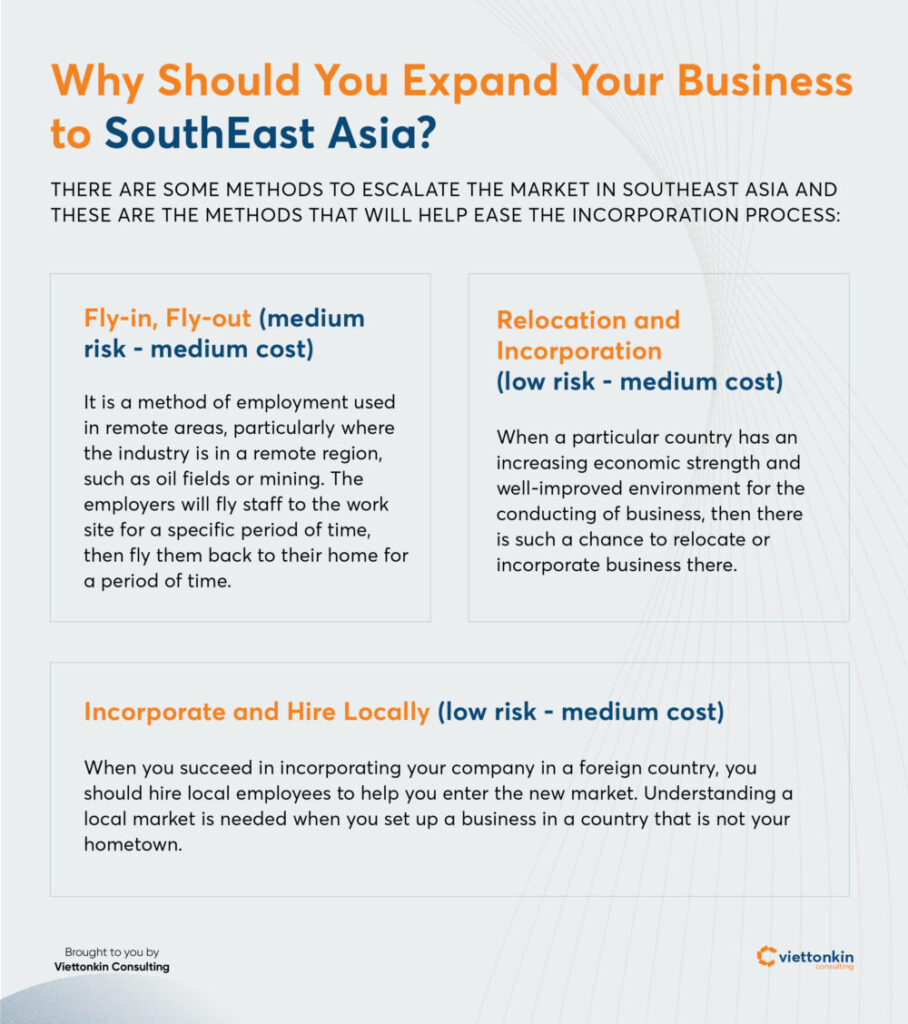
There are some methods to escalate the market in Southeast Asia, it also includes understanding the options, and considering both the opportunities and obstacles of each method. These are methods that will help ease the incorporation process:
Fly-in, Fly-out (medium risk - medium cost)
It is a method of employment used in remote areas, particularly where industry is in a remote region, such as oil fields or mining. The employers will fly staff to the work site for a specific period of time, then fly them back to their home for a period of time.
The opportunities for this method:
Better for the early stages of geo expansion
Can be used for scoping the market and building pipeline
May involve regular trips
The obstacles for this method:
Can be taxing physically due to long haul flights
Limited flexibility on meeting times and in-person presence
May have time zone-based communication lag
Relocation and Incorporation (low risk - medium cost)
When a particular country has an increasing economic strength and well-improved environment for the conducting of business, then there is such a chance to relocate or incorporate business there.
These are the opportunities:
Easier done in some countries which better task rate, less red tape, and low corruption
Better for legal and compliance consideration
Allows easier business transactions with incorporated status
However, this method has its obstacles:
Incorporation cost varies by country
Requires legal support
Has variable costs for marketing, administration, and employee relocation
Incorporate and Hire Locally (low risk - medium cost)
When you succeed incorporating your company in a foreign country, you should hire local employees to help you enter the new market. Understanding a local market is needed when you set up a business in a country that is not your hometown.
The opportunities for this method:
Profitable if managed correctly
Better in understanding language, culture, and way of doing business
Networking or relationship advantage which is important in Southeast Asia
Better business commitment pointed by local employees
The obstacles for this method:
Lengthy legal and banking processes
Requires familiarization with tax and regulations
Needs careful hiring for the first employees
After knowing these methods, you also need to look out for the tips for expanding a business in Southeast Asia. Moreover, these are the tips that you can consider for your Asia business development later:
Approach the Southeast Asia market as a multiple markets which significantly based on language, culture, technology maturity, and spending power.
As an entrepreneur, you should show commitment and physical presence because buyers in Southeast Asia expect a local presence or at least a locally established partnership.
Have a plan for at least two years to create footprints as businesses. You can also actively educate prospecting clients with your business value propositions and the pain points that your business can solve.
Different countries might have distinct levels of price sensitivity. There is sometimes a need to tweak global pricing models as Southeast Asia countries have strong bargaining cultures.
The above information is the reasons and opportunities why you should expand your business to Southeast Asia. There are many additional nuances worth exploring and also depending on the administration you may be looking at. In conclusion, it is a great thing to do if you want to do Asia business development in order to try a new market for your business because in the end you will have to do everything for your successful business.
Franchising as a business expansion method has become increasingly popular in Asia, especially in Vietnam. The country has a healthy economy, which has been growing in the last decade, also has mainly young-population of 94 million, and the most important is people are showing a strong interest in franchising. Not only that, many popular foreign brands are attracted by the business expansion there, meanwhile the local Vietnamese investors are looking for the opportunity to operate business under the well-known brands that Vietnamese are familiar with. Therefore, this article will offer you in-depth information about marketing entry strategy, focusing on franchising business. Let’s read until its end!
According to Vietnam's Ministry of Industry and Trade, Vietnam has experienced a 15%-20% growth in terms of new foreign and Vietnamese franchises entering the market for the last five years. Vietnam is expected to grow and recover, and the growth will slow to 8% - 12% in 2020 and revert back to its normal 15% - 20% growth in 2021.
Furthermore, many international franchisors continue seeking an entry in Vietnam as it is one of the most attractive markets in the ASEAN due to rising incomes and a rather young population. Since many businesses plan for long-term growth, reviewing new business opportunities like franchises is a wise thing to do, even in these challenging times since the actual franchise partnership may be months from when the discussion first starts.
There are companies that want to enter Vietnam, including food and beverage, education, services, and even hospitality chains. In addition, companies like Little Caesars Pizza, Delifrance, Mango Tree, Scholastic World of English, Helen Doron Kindergarten, Sureclean, and many others. The hotel chains, such as Marriott, Accor, Hilton, and others continue their search for the right partners.
However, some franchises have begun to adapt to the new environment by shifting their operation into online and accelerating their plans to move at least a part of their business online. In this case, F&B franchises have adapted well by focusing heavily on online deliveries. Then, hotels and catering companies have taken their businesses online to mitigate the impact to their normal business operations.
How To Market Franchise Business in Vietnam?
Creating a successfully target market with high growth potential, the business development team will need to resource properly, in which they must have the allocation of financial and human, marketing talent and senior leadership support. Moving from an opportunistic to a targeted approach for international expansion, it is critical that validating markets exist in each targeted region.
Moreover, the franchisor should select specific markets that are best suited for their brand or product and develop them as future validating markets, but the mistakes might occur as the validating markets are established. However, both failures and successes should be analyzed, and the criteria driving success and failure defined and internalized by the development team.
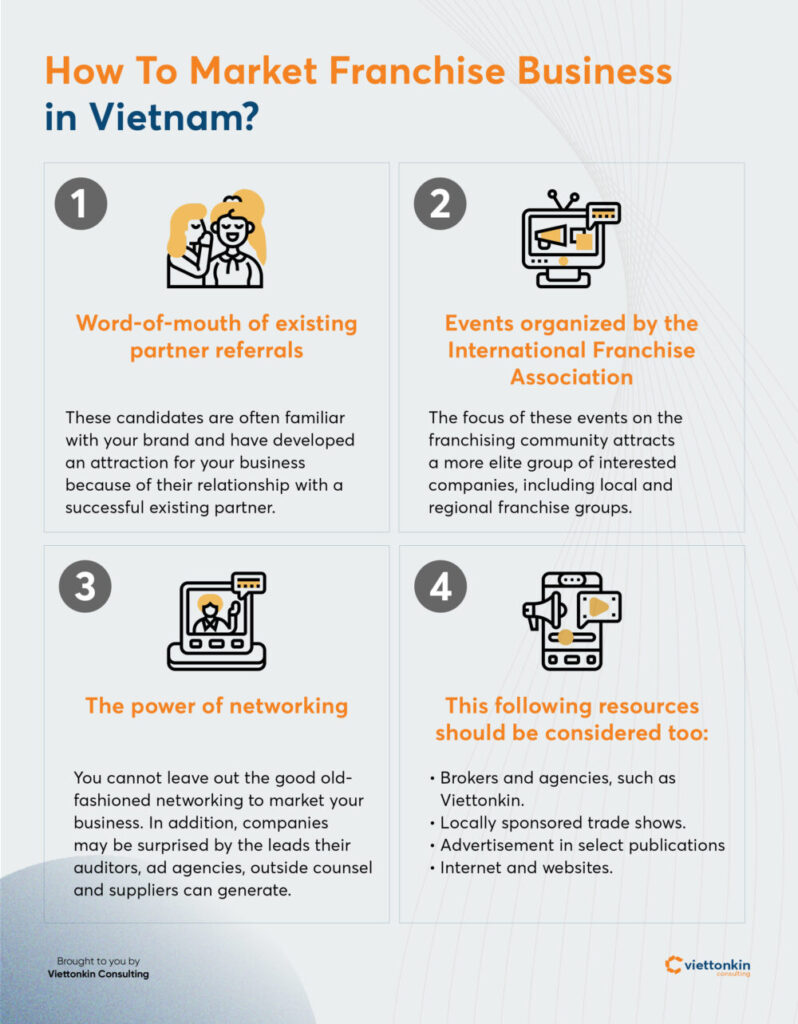
Therefore, there are some ways to market the franchise business in Vietnam, start from word-of-mouth to good old-fashioned networking. Here are the details information below:
1. Word-of-mouth of existing partner referrals
It is still the most powerful and valuable lead one will have. These candidates are often familiar with your brand and have developed an attraction for your business because of their relationship with a successful existing partner. They prepare better and give more realistic expectations of what it takes to succeed.
2. Events organized by the International Franchise Association
It is also a strong tool to market the franchising business. The focus of these events on the franchising community attracts a more elite group of interested companies, including local and regional franchise groups. If they are considering a portfolio approach to advantage their infrastructure, however these local and regional franchise groups can be their candidates for master franchising.
You cannot leave out the good old-fashioned networking to market your business. In addition, companies may be surprised by the leads their auditors, ad agencies, outside counsel and suppliers can generate. For instance, existing partner referrals, because this group has the same advantage of having a basic understanding of your business.
4. This following resources should be considered too:
Brokers and agencies, such as Viettonkin.
Locally sponsored trade shows.
Advertisement in select publications
Internet and websites.
The Franchising Business Opportunity in Vietnam
The COVID-19 outbreak in 2020 has affected in a positive way for this franchise business. It somehow accelerated certain franchise opportunities if compared to those past years.
One of the businesses is e-commerce, it is capturing a fast-growing online delivery market while at the same time minimizing the risk of other future pandemics. Another interesting fact to add is that the health emergency has pushed companies to implement their digital strategies nearly overnight.
Modern retail will continue to grow faster as traditional markets are seen as less safe, and the number of supermarkets and convenience stores continue to grow at a faster pace to meet the demand.
These are the best franchising opportunities for foreign brands in the country:
Food and Beverage, including fast food, fast casual, casual and fine dining, snacks and beverages, and desserts.
Education and Training (for young children, teenagers and adults), and other vocational training franchises (for hospitality management, tourism, and many more).
Another education franchises that are popular, such as English Language Learning Centers, and other languages (e.g mandarin), STEAM based learning (Science, Technology, Engineering, Art/Dance/Music, Math), Robotics, Computer Programming or Coding, professional skills development training for adults, Information Technology (IT), and Finance.
Retail, fashion, and lifestyle based franchise, for example convenience stores, fitness & health, children’s entertainment, health supplements franchises, health and beauty spas.
The rapid increase in car ownership presents good opportunities for franchises to supply the demand, for instance auto repair and maintenance franchises.
As mentioned above, there are still a lot of opportunities to enter the market in Vietnam through franchise business. After getting hit hard by COVID-19, the franchise businesses still survive and operate well.
If you have a plan to get into the market through franchise, just keep it in mind that you must have the right market for your business. Not to forget about networking and visiting the exhibitions to strengthen your business. In conclusion, if you are unsure and need help, please contact us below. Viettonkin is always ready to assist you anytime!
Over the recent years, Vietnamese businesses and entrepreneurs have continuously grown and prospered, and also significantly contributing to the country’s economic development. Furthermore, Vietnam has also become an attractive destination for ASEAN investors, and any other investors like from the United States and Europe. Therefore, many investors want to establish a company, a branch, a representative office, or set up joint ventures to understand the local market. This article will provide you with Vietnamese entrepreneurs, finding local partners, as well as to choose best joint ventures partners in Vietnam!
Vietnamese entrepreneurs somehow face numerous difficulties in a context of deep international economic integration. They have been encouraged to be proactively developing strategies to gradually become a capable and qualified force that plays a key role in economic development. It is as well as enhancing the capability for international economic integration.
The Party and State have made numerous policies and guidelines to encourage the development of enterprises as well as promote the role of entrepreneurs in the cause of national construction and defence. Today, Vietnam has over 800.000 enterprises and around 5.2 million business households with over 5 million entrepreneurs.
However, it has proved that the pavement of the way for enterprises' development was in the right direction. Many Vietnamese entrepreneurs have been listed among the top global “US$ billionaires.” Those entrepreneurs have big dreams and ambitions with aspirations of contributing to make the country more powerful, prosperous and civilised.
These rapid increases in the number and scale of enterprises across all economic sectors, the Vietnamese entrepreneurial force has continuously developed, significantly contributing to the implementation of socio-economic development strategies, creation of jobs for employees, and the settlement of social welfare issues.
Another fact to add, businesses have contributed over 60% to the country’s GDP, around 70% of state budget revenue and has attracted millions of employees. Thus, the promotion of the country’s economic development could be considered a mission and responsibility of the entrepreneurial business community.
Additionally, some companies are enjoying stable earnings brought by joint ventures they established with foreign partners, but their core businesses remain insignificant. Plus, these joint ventures are usually foreign direct investment (FDI) projects in which State-owned enterprises contribute capital and land use rights, while foreign companies contribute money and technology.
Joint ventures indeed can be a great way to make money, but in order to do this, you must know how to find the right local partners that will provide what you need. Let’s keep reading!
Finding The Local Partners for Joint Ventures
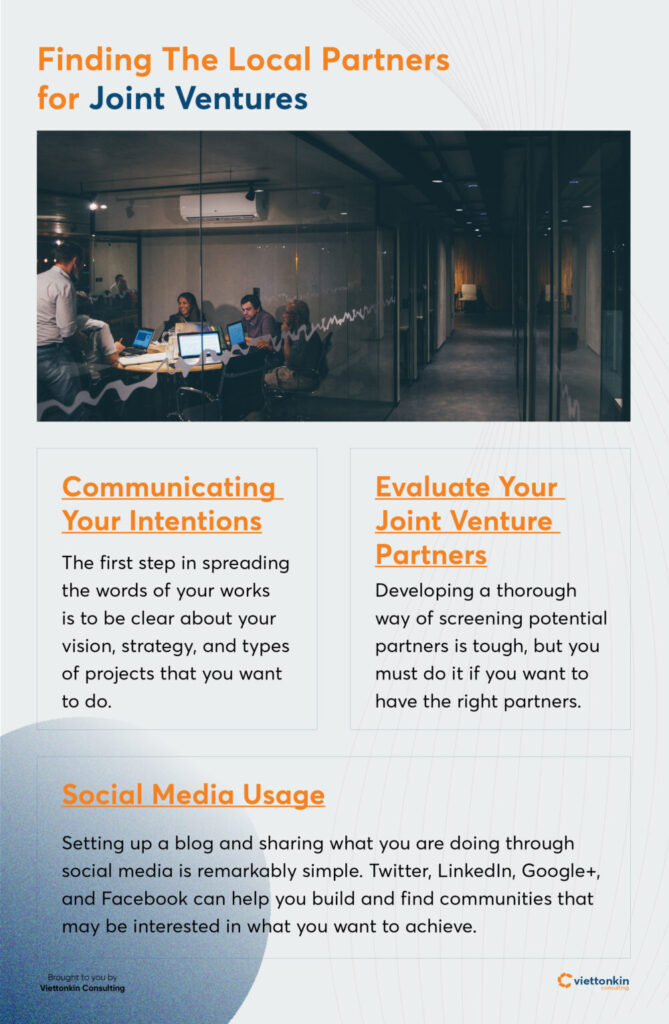
Finding local partners for joint ventures is not as difficult as you think, it is relatively easy. Nevertheless, you have to utilize tools or sharpen your skills to get more local partners for your significant business development. Thus, there are ways to find the rightest local partners for you.
1. Social Media Usage
Setting up a blog and sharing what you are doing through social media is remarkably simple. The websites like WordPress and Squarespace let you set up a website in minutes. In addition, Twitter, LinkedIn, Google+ and Facebook can help you build and find communities that may be interested in what you want to achieve. You only need to be confident to put it out there and communicate clearly about your doing, because people are watching and you never know where a potential partner will come from.
2. Communicating Your Intentions
The first step in spreading the words of your works is to be clear about your vision, strategy, and types of project that you want to do. If you desire of more additional partners, you can do this following actions:
Asking your inner circle to recommend your idea to their friends or family members.
Posting your idea on a discussion forum and seeing who responds.
Posting your ideas on LinkedIn groups that have formed around your business.
3. Evaluate Your Joint Venture Partners
Developing a thorough way of screening potential partners is tough, but you must do it if you want to have the right partners. You can consider this following criterias to make the right partners:
Different operational skills: find someone whose skills complement rather than replicate yours.
Similar work habits: you have a shared view as to how much you will work to achieve your goals.
Emotional buoyancy: you need the capacity to support each other during the highs and lows of the project.
Total honesty: you and your partners must be committed to telling each other the truth all time.
Choosing The Best Joint Ventures for Your Business
Determine the ideal business partner in a joint venture is one that has resources, skills and assets that fulfill your own. The joint venture has to work contractually, but there should also be a good fit between the culture of the two organizations.
There is a good starting place to assess the suitability of existing customers and suppliers that you already have a long-term relationship with. Additionally, you can think of your competitors or any other professional associates.
There are things you need to consider when assessing the suitability of partners, and these are:
How well do they perform?
What is their attitude to collaborate and do they share your level of commitment?
Do you share the same business objectives?
Can you trust them?
Do their brand values complement yours?
What kind of reputation do they have?
You also must carry out some basic due diligence checks when looking at new potential partners. Firstly, examine their legal status, then make sure that they have the right to enter the joint venture. You should ask yourself these things:
Are they financially secure?
Do they have any credit problems?
Do they own assets that they will be putting into the joint venture?
Do they already have joint venture partnerships with other businesses?
What kind of management team do they have in place?
How are they performing in terms of production, marketing and workforce?
What do their customers and suppliers say about their trustworthiness and reputation?
Before considering joint ventures, you probably need to pay attention to these things that are explained above. Having a knowledge of local partners, finding the local partners, then finally choosing the best joint ventures for your business are rather difficult, especially when you do not plan them out.
In conclusion, if you are still unsure about finding the local partners or what the best joint ventures that you are interested in, you can ask us for our help! Viettonkin is here to assist you and your business anytime.
Mergers and Acquisitions function as a double-blade that can create or destroy a company. At worst, a disastrous deal can cost the company millions of dollars. On the other hand, smart transactions can accelerate a company’s gain in the market over its competitors, propelling it to the front of the race. Over the last ten years, Vietnam has witnessed billion-dollar M&A deals driven by strong foreign interest in the M&A market and divestment of various state-owned enterprises. If anything, Vietnam’s appetite for M&As is increasing. However, the M&A lands of Vietnam are also littered with examples of failures. This article will outline the main risks associated with M&A in Vietnam and general advice on how to avoid them.
Difference in domestic and international Mergers and acquisitions regulations
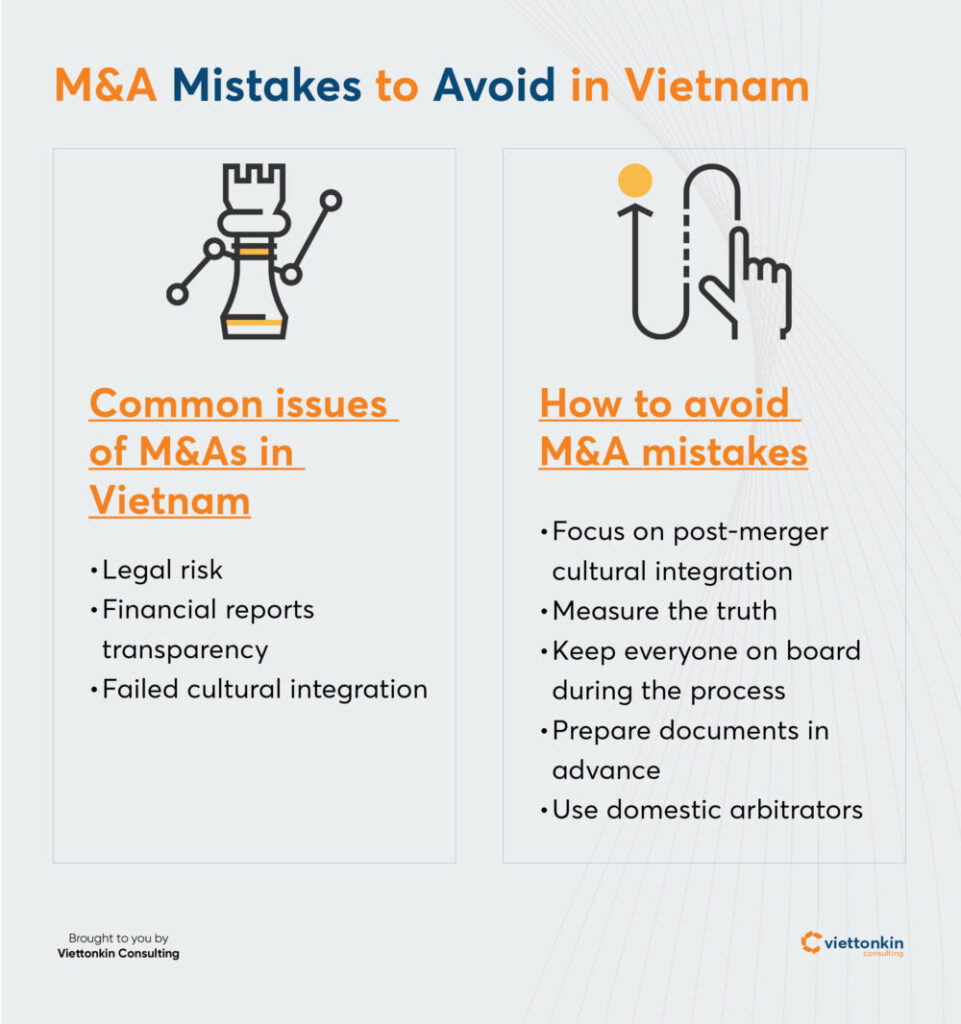
One of the main risks of Mergers and acquisitions “collapses” is the legal risk that leads to disputes and litigation that cost both time and money. Most of the conflicts occurred because Vietnamese and international laws have different regulations. Therefore, from the beginning, it is necessary to have a clear agreement in order to identify legal risks and avoid any mistakes from the two parties. In the context of Vietnam's increasing integration, trade disputes are inevitable. Therefore, in this challenge, the more thoughtful the equipment of legal knowledge, the more beneficial it will be.
Financial reports transparency
Investors often complain about the transparency of financial reports and online data room when assessing potential mergers in Vietnam. Kevin Snowball, chief investment officer at PXP Asset Management, pointed out that investors are worried about under-the-table transactions that might take place at SOEs, “where people might just sell the shares to their friends”. Other issues include the willingness, or lack of, group leaders to meet international investors and provide transparent details on their finance, operations, and strategies.
Regarding financial reports, Vietnamese accounting standards contain vast differences to the International Financial Reporting Standards (IFRS), making it harder for overseas investors to make sense of a Vietnamese company’s earnings and losses. There are also no official requirements to release corporate information in English, which can also discourage investors abroad.
Failed Cultural integration
Deloitte has estimated that failed cultural integration is a primary cause in about 30 percent of failed M&As. Bain & Company also identified cultural integration as the number one cause of Mergers and acquisitions failure. This is especially true in Vietnam, when sometimes companies are so blinded by the potential for market growth from a merger that they do not take into account other human and cultural factors.
The first common mistake within the Vietnamese market is short-cutting the M&A process. Anyone who has lived through an M&A knows that it can be a long, unpredictable, and sometimes uncomfortable journey where potential risks abound. Most of the time, local vendors are not sufficiently prepared for the extensive time and effort an M&A deal requires while foreign investors breach overly optimistic timelines.
Also, during the formulation of the deal structure, parties often overlook the closing and post-closing steps of the deal, where cultural integration plays a crucial role. It usually takes months, maybe even years, for two cultures to mesh and find common ground. Claiming victory prematurely can frustrate workforces and create conflicts among the leaders
Vietnamese people still have a strong Asian culture in thinking and acting, considering the company as their "child" so they rarely want to sell it. Therefore, many domestic enterprises are still wary of M&A activities or tend to get tangled up in overly complex and inflexible deal structures. The choice of structure can depend on a number of factors such as the regulatory framework in Vietnam, the type of acquisition, type of business activities, the relationship between the target and buyer… In case of foreign investors, the existing foreign ownership restrictions and conditions can significantly impact M&A deal structures. Thus, it is important that foreign investors ensure the proposed structure works from a Vietnam perspective and be open to considering alternatives at an early stage. (Related article: What you need to know about mergers & acquisitions in Vietnam)
Practices to avoid Mergers and acquisitions mistakes
Focus on cultural integration post-merger
Instead of getting caught up in the technical aspects of the integration, how well the organizations handle the “human” aspect can make or break the deal. Post-merger cultural integration can be achieved by creating a workstream that identifies what is shared between the two organizations and how to create common ground. A cultural workstream ensures both entities respect each other’s values. Also clarify expectations around new leadership to facilitate integration. This is important for Vietnamese companies where leadership styles are culturally different from foreign organizations. Clearly communication expectations lets leaders know when and how to adjust their behavior to drive integration.
Measure the truth
Regularly survey the field to get an honest assessment of how the integration is progressing. Mediate your expectations and anticipate potential risks along the way. When events are unfolding rapidly in an Mergers and acquisitions, we tend to demonstrate greater biases and make more assumptions. To figure out how well the organization is handling the integration, it is important to keep all levels of organization on board and encourage open dialogue so the middle leadership does not feel left out.
Prepare documents in advance
Encourage the vendor to start collating documents for due diligence purposes at least four weeks in advance of when they will be required given the lack of online date among Vietnamese companies. Otherwise, expect the deal timeline to drag.
Select domestic arbitrators
The ability to communicate with and gain support of the court in the country is one of the advantages of including domestic arbitrators. Domestic arbitrators can bridge the gap between international regulations and domestic Mergers and acquisitions laws in Vietnam while anticipating potential legal risks along the way. The use of domestic arbitrators thus helps businesses reduce costs and facilitate progress during integration.
About Us
Founded in 2009, Viettonkin Consulting is a multi-disciplinary group of consulting firms headquartered in Hanoi, Vietnam with offices in Ho Chi Minh City, Jakarta, Bangkok, Singapore, and Hong Kong and a strong presence through strategic alliances throughout Southeast Asia. Our firm’s guiding mission is aimed towards facilitating intra-ASEAN investments and connecting investors in Southeast Asia with the rest of the world, thus promoting international business relationships and strengthening inter-nation connections.




 English