Vietnam's food trade industry is one of the most dynamic sectors in the country. Fueled by an expanding middle class, rising disposable incomes, and shifting consumer preferences, the increasing demand for high-quality food products is undeniable. From bustling markets in Ho Chi Minh City to modern supermarkets in other major cities, the opportunity for both […]
Vietnam's food trade industry is one of the most dynamic sectors in the country. Fueled by an expanding middle class, rising disposable incomes, and shifting consumer preferences, the increasing demand for high-quality food products is undeniable. From bustling markets in Ho Chi Minh City to modern supermarkets in other major cities, the opportunity for both […]
Whether you are looking to outsource your business’ operations to Vietnam or setting up a business, choosing a location for manufacturing activities in Vietnam can be a daunting task for investors unfamiliar with the market.
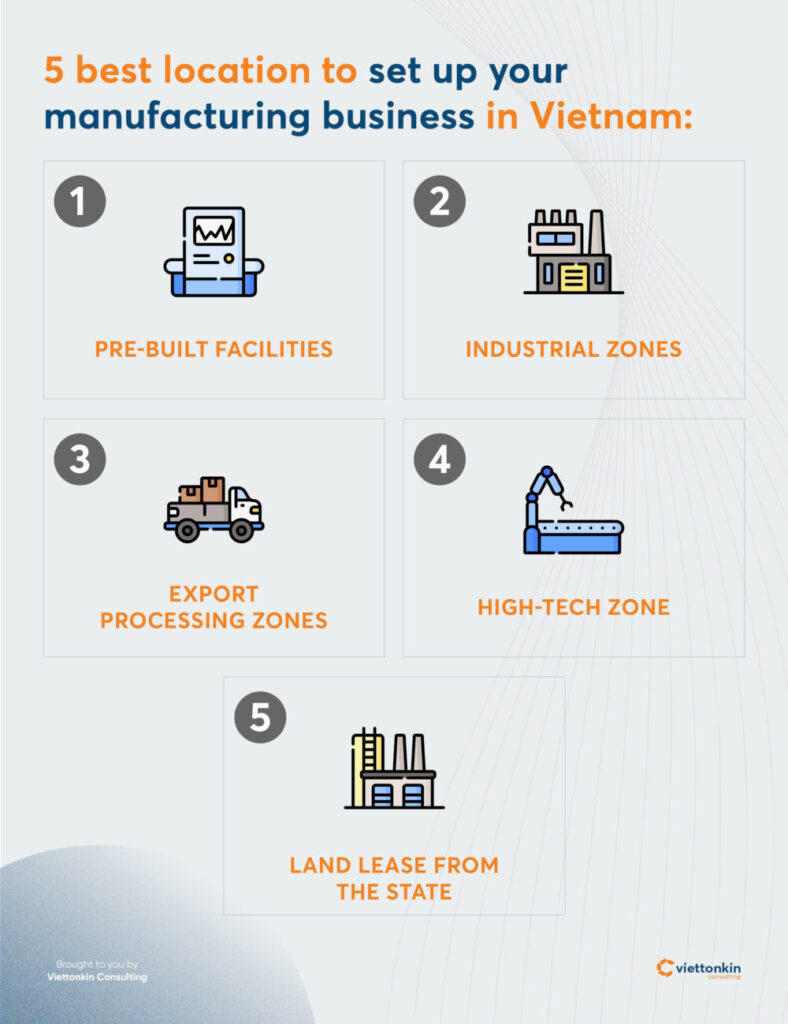
Factory locations may be located inside or outside industrial zones or special economic zones, export processing zones, or hi-tech zones. When choosing a location to set up manufacturing business, investors need to take into account the industry specialization, infrastructure, and scale of business operation. The following options are recommended to investors looking to set up factories in Vietnam.
Investors can rent ready-built factories and warehouses for lease by companies registered in Vietnam. According to Vietnam’s Briefing in 2019, ready-built factories were in the highest demand with investors increasingly moving factories to Vietnam, recording more than an 85 percent occupancy rate. Binh Duong and Dong Nai in the southeast are the markets with the highest demand, given their access to transport infrastructure. This plan is suitable for small to medium scale businesses looking to lease land of less than 8 hectares. These facilities are designed in accordance with production and business requirements and international safety standards. This ensures brisk business set-up while gaining access to strategic economic regions.
Industrial zones
This plan is suitable for investors looking to lease land with a lease term of 40-50 years and an area of more than 8 hectares. Industrial zones are specific areas earmarked by the government for the production of goods and services. Industries are usually concentrated in certain industrial zones, which provide incentives for businesses that set up there. Industrial zones are popular locations for manufacturing businesses in Vietnam. As of 2018, according to Vietnam briefing reports, there are 328 industrial zones countrywide, 249 of which are in operation.
Preferential tax rates are offered by the government to investors located in industrial zones in Vietnam. Other indirect taxes, such as Value Added or Special Consumption Tax, may also be reduced on a good-by-good basis. These tax incentives can help offset the higher wages and rental fees in these areas.
See more at Top locations to start businesses in Vietnam to learn more about Industrial zones and how to narrow down your list of potential business locations.
Export Processing Zones
In the case of investors seeking support from specific exporting regulations, it is required that the business be an Export processing enterprise (EPE). EPEs, as defined by Decree No 82/2018/ND-CP, are enterprises that are established and operate in an Export Processing Zones (EPZ) OR that specialize on a manufacturing product for export and operate in an industrial zone. EPEs are also required to be separated by fence systems, have ports, entrance and exit doors and fulfill requirements by customs authorities related to non-tariff areas and rules on import and export duty. Export processing zones are often located within industrial zones and focus on manufacturing goods for export.
Export processing zones have become a popular destination for foreign investors now that Vietnam has emerged as a China-plus-one destination for companies looking to outsource operations to reduce cost. Their tariff-free trade and access to low-cost labour make export processing zones an ideal location for manufacturing business in Vietnam. Due to their location within industrial zones, businesses can also enjoy tax incentives. EPEs set up in export processing zones are allowed to sell goods to the local market with import duties payable by the recipient. However, EPEs set up in industrial zones other than export processing zones are prohibited to sell to domestic enterprises in the Vietnamese market.
High-tech zone
Hoa Lac Hi-tech Park in Hanoi is the first Hi-tech Park in Vietnam to receive special mechanisms and incentive policies, allowing investors and companies investing in Hoa Lac Hi-tech Park to enjoy preferential tax rates and other support. It was built as a center of research, development, and hi-tech application and consists of various functional zones such as research and development zone, software park, high tech industrial zone, education and training zone. However, the downside of this high-tech zone is that it is operating like industrial parks rather than like sci-tech hubs, except that the cost of factory rental is much higher. Thus, the high-tech zone receives no foreign-invested project and only 4 domestically high-tech projects in 2019.
Land lease from the state
Renting land directly from the state is suitable for investors who plan to lease land for 40-50 years or more and need a large area. The drawback of this plan is that it is a time-consuming and costly process to get approval for land use plannings as well as site clearance plans from the government
When a company intends to locate its business outside the industrial zone, export processing zone, hi-tech park, economic zone, etc., the investor must contact the Department of Natural Resources and Environment for consultation as to where to implement the projects. If a specific location has been decided outside an industrial zone, export processing zone, high-tech park ... (for example, leasing facilities, factories of another enterprise ...), the above company needs to work with The Province's Department of Natural Resources and Environment to find out if the proposed site is consistent with the land use planning.
As we have already known, Singapore is having a good reputation for economic growth in Southeast Asia, and even around the world. Thus, many foreign companies would like to enter the market there. One of the strategies that can be done is through Mergers and Acquisitions (M&A). In this article, we will introduce you to a guide for M&A in Singapore, so you will know the useful tool for corporations to venture the business internationally. Let’s find out!
Overview of Mergers and Acquisitions by Value and Industries
Since 1985, more than 16.139 M&A transactions have been announced with a value of almost 849.67 billion USD, and it is over 925 deals with a total value of more than 78 billion.
In January 2018, there were 54 transactions with a value of 2.30 billion USD which represented the highest number of deals in March 2011 with 103 announced deals and a value of 3.75 billion USD.
In the year of 2019, M&A in Singapore was entering a healthy phase, even though there was a lower level of deal activity compared to 2018 and 2017. The Singapore M&A market registered 630 deals, valued at a total of USD72.4 billion in November 2019.
The industry with the largest M&A activity in terms of transaction value has been in the financial sector. It represented 16.8% of all deals with a total value of 753 billion USD. The second largest industry by value is the materials sector with 558 billion USD worth of transactions. The industrial industry reached the third rank with 527 billion USD.
M&A Activity and Trend in Singapore
Singapore’s M&A activity in 2019 has a total of approximately 35.3 billion USD, with a total deal count of 134, which was up approximately 125.6% from a year ago.
At the beginning of 2020, an unexpected challenge due to COVID-19 outbreak. The global markets have plunged, heavy losses on Wall Street as the outbreak triggered a sharp global economic downturn. However, the stock market in Singapore has fallen to a ten-year low as of mid-March 2020, following the global rout that saw the US stock market recording their biggest one-day loss since the 1987 market crash.
M&A trends in Singapore saw significant private equity and venture capital deal activity in 2019 increased. Additionally, the technology remained the most active sector in 2019. Singapore’s start-up ecosystem is now flourishing with over 220 venture capital deals per year that is worth close to 4.2 billion USD. Singapore’s Finance Minister stated in the 2019 Budget Speech, there were more than 150 global venture capital funds, incubators, and accelerators that are based in Singapore.
The private equity and venture capital funding that has fueled M&A activity in the SEA region is expected to continue growing.
The Mergers and Acquisitions Scheme in Singapore
The M&A scheme offers benefits for companies that acquire shares in a target company. The scheme is also applicable to Singapore registered companies that acquire the ordinary shares to a target company, either directly or through wholly-owned subsidiaries.
According to M&A scheme, the government will grant the following benefits to an acquiring company, such as, an M&A allowance, which is calculated on the total cost of the acquisition of shares in the target company, second is a stamp duty relief, and the last is Double Tax Deduction (DTD) on the transaction cost.
The M&A allowance is a tax allowance granted to the acquiring company for each year of assessment (YA). Furthermore, the allowance granted is equal to 25% of the total acquisition value for each YA, with a purchase consideration cap fixed at $40 million.
Meanwhile, the stamp duty relief covered at $80.000 for each financial year, and the DTD on transaction costs which earned during the share acquisition process. These transaction costs include legal fees, professional fees, valuation fees, and so on. For this deduction, the cap on the transaction cost is $100.000.
Mergers and Acquisitions Structure and Regulation in Singapore
This part is about the acquisitions of owned companies that are structured in Singapore’s jurisdiction. However, the acquisition of shares or the business and assets or privately owned company is affected by the sale and purchase agreement between the relevant parties.
Acquisitions may also be structured as put-and-call arrangements, but are less common. The acquisition of privately-owned companies can also be structured by way of a contractual offer, which is followed by a scheme of arrangement under section 210 of the Companies Act or the statutory amalgamation procedures under section 215A of the Companies Act.
Furthermore, the transaction process depends on the complexity of the issues, the type of your business, the number of parties involved, and whether the transaction involves a bilateral negotiation or formal auction sale process. The parties will typically enter into a confidentiality or non-disclosure agreement at the outset of the acquisition transaction.
The laws regulate the acquisition in which parties are generally free to negotiate the terms and conditions of the sale and purchase agreement for private M&A transactions. In doing so, they would need to take into account the Companies Act that is applicable for all companies incorporated, registered or carrying on business in Singapore.
The other statutes and regulations may be applicable or relevant to private M&A transactions, including those relating to the transfer of employees, data protection, ownership and transfer of real estate and competition. If the buyer of the seller is a company listed on the Singapore Exchange Limited (SGX), the SGX’s listing rules will also be applicable in relation to the acquisitions and disposals.
Moreover, parties are free to decide on the governing law of the transaction documents. Most transaction documents for the sale of Singapore companies are governed by Singapore law. The legal formalities and procedures are also for the transfer of shares, liabilities, business or assets that are subject to Singapore law.
With these interesting M&A activities, schemes and regulation, many foreign companies decided to expand their businesses in the country through acquisitions. In conclusion, there are guides for you if you wish to do M&A in Singapore one day. However, if you are unsure or need assistance, you can contact us below. Viettonkin will always be ready to help you!
Singapore has become a major trading and financial hub. It also has the infrastructure and expertise that Chinese corporates need to access other ASEAN markets. The country has a stable tax, legal and regulatory systems, business-friendly environment that will make it easier to do business there. With all these topnotch infrastructure and services, Singapore offers an excellent base to expand to the rest of ASEAN markets. This article will give you information about how Singapore became a trade and logistic hub, also the opportunities for ASEAM traders. Let’s find out!
The location of Singapore in the major East and West shipping lanes coverage was equaling $5 trillion, and it also makes the country one of Asia’s largest trading hubs. The country’s central role in ASEAN and economic partnership with China is becoming a strong point of commercial activity there and making it an effective springboard for regional opportunities.
The Minister for Trade and Industry, Mr S Iswaran has an opinion that eight out of ten of the world’s leading commodities trading companies have a presence in Singapore, and the government will also continue to strengthen the ecosystem to maintain its status as a leading centre for commodities.
In addition, Changi Airport has been addressed as the world’s best airport by travellers for the third year in a row, based on the 2015 World Airport Awards. Port of Singapore Authority (PSA) is also considered as the world’s second-busiest port in the globe, and it means trading with the country for both small and large business investments is going well.
The rise of Singapore as a commodity trading hub is well known amongst ASEAN countries, it has also been responsible for the generation of demand for the professionals from this domain. As it continues to attract professionals from all walks of life, the commodity traders find it easy to recruit highly qualified English-speaking professionals.
Furthermore, Singapore has kept its doors open to trade, and it has allowed it to draw considerable foreign direct investment (FDI), and become one of the top countries in the world for FDI. For instance, back in 2018, it attracted around USD77 billion investments, and it was more than 53% of the USD145 billion that has flown into Asia.
As the third-largest foreign exchange market, Singapore offers the best US dollar liquidity in Asia. It comes handy to the commodity players in the value chain, such as the large miners to the independent brokers and traders who chose to open a company in Singapore at the right time.
In 2015, Singapore was ranked at the top in the Ease of Doing Business, because Singapore has political stability and makes the country a high-value place of doing businesses. In addition, its ability to retain AAA credit rating in the global economy is appreciated. The rating is important for volume traders because it brings the cost of inventory down.
A large number of traders in Singapore is playing a vital role in the demand and supply chain. It also drives the costs of commodities down and increases the supply. Eventually, it gives them better security and provides opportunities.
The Opportunities for ASEAN Traders
Singapore trading hub is the leader in all major commodity sectors. Moreover, Singapore ranked 4th largest trading hub in the energy sector, also ranked 2nd largest trading hub in the metals sector and lastly has ranked 2nd largest trading hub in the agriculture sector.
Singapore’s effort to be the great traders doesn't stop there, and the country has established itself as a reputable global trading hub with a significant number of key international players who have set up the base. Not only that, the government aims to create a supportive environment that will enhance Singapore’s position as a global trading hub.
The International Trading Institute is working together with the Singapore Management and Industry Partners to offer a business degree specialised in international commodity trading. The International Trader Development Fund offers to fund the course fees for companies to send their employees to the ITI for professional education courses. The Trader Development also aims at developing talent in the trading sector.
There is an exclusive event in Singapore that happens every two years in order to boost economic growth in the trading industry. It’s The Global Trader Summit (GTP), where the top business leaders in the trading industry are invited to discuss major trends and fundamental issues in order to shape the future global trading markets.
The GTP aims to achieve its objective by allowing companies who are part of its programme, to benefit from a 10% concessionary tax rate on their qualifying trade income for a five-year renewable period. During this period, the companies can establish their regional or global trading network with Singapore as their base. Once they are able to demonstrate sustainable growth projections that are in line with GTP’s requirements, they can apply for the 5-year renewable GTP scheme.
For all these years, the seaport has been a key role in the Singaporean economy. The government has the policy to maintain low import tariffs for the port’s revenues, technological progress, and dynamically growing trade with China, Hong Kong, Indonesia, Japan, South Korea, and Malaysia.
Furthermore, this small city-state has been consistently implementing the free trade’s policy and discovers it as an opportunity for further development of Asia's economies.
One of the reasons why ASEAN countries want to venture business in Singapore is its high-end manufacturing with the latest technologies, including semiconductors and consumer electronics, as well as machinery, transport equipment and ships.
The Singaporean government also pays attention to give more funds that are allocated in other sectors, such as aviation and aeronautics, precision engineering and life sciences, biotechnology, medical equipment and pharmaceuticals. Moreover, the government is committed to investing in infrastructure projects and new industrial parks.
There are a lot of opportunities for ASEAN traders to have a business in Singapore, as the government itself has poured investments to keep the sectors growing. In conclusion, the trade and logistic sector will be key to support the long-term economy of Singapore!
Despite the ups and downs of Vietnam’s economy over the past 10 years, FDI inflows remained stable with the cumulative total registered FDI reached the level of approximately US$318.72 billion by the end of 2017.
FDI into Vietnam in the 3 years, from 2015 until 2017 has continuously increased as compared to the period of 2010 until 2013. Most of the capital inflow was deployed into projects. No surprise to us, that FDI between Vietnam and Singapore is growing significantly until today.
However, Vietnam - Singapore cooperation is complementary to each other. In addition, Vietnam is acknowledged as high technology and it identifies for attracting Singaporean investment in the near future.
In this article, you will be provided the information about FDI between Vietnam and Singapore in the past 10 years, from 2009 until 2019. You can also see Viettonkin Consulting Market Readiness Assistance to help you asses your FDI initiative here. Let’s keep reading!
Understanding FDI Between Both Countries In The Past 10 Years
Vietnam’s strong and stable growth performance over the past decade has been an attractive magnet for foreign investors, especially from Singapore. Their market share accounted for 73.9% of total FDI of all industries, including manufacturing, wholesale & retail trade, and real estate.
As more than 10 years ago, FDI inflows were focused on the high-end residential segment. The leading names in the market, such as Keppel Land, CapitaLand with the first high-end real estate projects in Vietnam, such as The Estella or The Vista. The total supply of high-end apartments in Ho Chi Minh City as of 4Q 2007 was approximately 1.700 units, and about 1.000 units were from FDI projects.
Furthermore, the Vietnamese government also prioritizes advanced technology projects of the trend 4.0 revolution, projects with modern management, and the connection between production chains and global supply.
Besides, Singapore has invested in Vietnam largely in the manufacturing sector, and Singaporean investors invest in the country in two business types, Wholly Foreign Owned Companies and Joint Venture Enterprises.
From 2015 to 2018, FDI outflows of Singapore to Vietnam by sectors were in a good shape. The accumulation of three main sectors was manufacturing with 30.118 million USD, while wholesale & retail trade was 5.153 million USD, and lastly, real estate activities were 4.656 million USD.
Moreover, the annual growth rate within the year of 2015 to 2018 in the financial and insurance services sector was 27.8%, meanwhile, the construction sector was 27.2%, and the real estate sector was 24.5%.
Speaking of the real estate sector, in the year of 2018 was also marked as a 10-year period since the downturn of the real estate market, and followed by 5 years of market recovery. Given the monetary policies are expected to stay neutral in order to support growth, when FDI inflows in the hundred millions of dollars. It was expected to enter the real estate market in Vietnam, and hoping to continue stabilizing and growing.
With the recovery of the real estate market, Singaporean investors are pouring their capital into Vietnamese real estate. This is proven by the range of large-scale property projects from the likes of CapitaLand, Keppel Land, City Development, GuocoLand, Mapletree, Kusto Home, Sembcorp, and Ascendas.
Then in 2019, Vietnam’s FDI in the manufacturing sector amounted to 24.560 million USD, and for the real estate activities was 3.880 million USD. Furthermore, the compound annual growth rate from 2014 to 2018, for the administrative and support service activities was 117.9%, while the electricity, gas, steam and air conditioning supply was 68%, and the last information and communication was 67.1%.
The Upcoming FDI Projects for Both Countries
Singapore is still becoming the largest investor in Vietnam, which is accounting for 58% of total newly-licensed FDI in the first 5 months of 2020.
According to Mr. Sagara Hirohide, the director of Marubeni Vietnam Company in Hanoi, Vietnam’s location in the long coastline and seaport system, is making the country to play a huge role in the international oversea shipping system.
Besides, Vietnam has another sector which is consumer and e-commerce that is quite attractive to foreign investors, and it also can raise the purchasing power of the local middle class.
As Vietnam’s consumer sector is maturing, Singapore’s food service and lifestyle brands can tap into this market by providing more options and customized experiences.
According to Kim from Enterprise Singapore, the Vietnamese government is taking action to build a number of supporting policies in order to create conditions for innovation and unblock the financial resources for these activities.
Hence, Singapore sees these opportunities for their technology companies and startups to tap into the vibrant ecosystem, and the country can find partners, co-innovate and offer solutions through action.
Despite the real estate, education, manufacturing, and healthcare sectors, there are other sectors, including renewable energy, the consumer sector, and infrastructure that are now playing a big role for Singaporean firms in the Vietnamese market.
Back in 2006, Singapore-Vietnam Connectivity Framework Agreement launched six sectors of cooperation. These are education and training, finance, information technology and telecommunications, investment, trade and services, and transportation.
Today, Singaporean investors are targeting the sectors which involve the fast-growing middle class of Vietnam, and these are lifestyle and consumer sector, plus F&B and retail sector. It strengthens the fact that Vietnamese consumer is increasing and vibrant, and followed by the development of numerous new malls.
As Vietnam continues digitizing, more online shoppers may be expected, and Singapore companies may collaborate with local partners, as well as offer related services, such as e-payment solutions.
With this rapid development, demand for education and vocational is also set to grow. Co-working space is also taking the potential industry because Vietnam is acknowledged as a fast-growing startup ecosystem.
In conclusion, these sectors will definitely be growing stronger, and it may be followed by new sectors in the future. The FDI projects between Vietnam and Singapore will be expected to rise, and the Vietnam’s economy has enjoyed significant growth as well.
As we have already noticed that Vietnam has become a growing destination for foreign investors in Southeast Asia. Despite the manufacturing sector or any other prominent sectors, it turns out the demand for the education and training sector is reaching new heights. The education and training sector is becoming a favorable opportunity for foreign investors to enter the market. Now, you may ask yourself how does it go? Thus, this article provides you with information about Investment opportunities in Vietnam for foreign investors. You can also read here about how Viettonkin Consulting helps your business expand to Vietnam.
Overview of The Education and Training Sector in Vietnam
Vietnam’s young population and the government’s commitment to improving education offers more opportunities to invest in for foreign investors. Since 2000, the government has committed approximately 15%-20% of public expenditure on education, and it has become one of the highest in ASEAN.
Furthermore, the education and training in Vietnam have made many successful achievements in the last 3 decades, it includes forming a unified and diverse national education system in all study and training levels.
According to data from the Statistical Yearbook 2019, Vietnam has more than 15.4 thousand pre-school institutions, 27.7 thousand general education institutions, such as primary schools, junior high schools, and high schools. Also, 237 formal universities, and more than 3.000 vocational education institutions.
In the academic year of 2019-2020, the number of students nationwide has over 5.3 million children enrolled in pre-school, while 17 million students participate in general education, and over 1.5 million students enrolled in educational institutions. This does not include professional secondary schools and colleges that were managed by the Ministry of Education and Training.
Over the past decade, Vietnam has also achieved success to attract foreign investors in the Education and Training sector. Based on data from the General Statistics Office, it shows how foreign investors are optimistic and confident to invest in the education and training sector with large-scale projects in Vietnam.
Back in 2009, Vietnam had 128 projects of FDI in education and training with a total registered capital of 275.8 million USD. Then 10 years later, the cumulative number of projects has quadrupled to 526 projects and the registered capital has increased sharply by 15.8 times, and reached 4.376 million USD.
In 2019, 72 projects were licensed with a total registered capital of 67.4 million USD. Hanoi and Ho Chi Minh City are the most attractive places for investment in this sector. With this huge number of FDI projects in the education and training sector, it gives a lot of opportunities for Singaporean and Southeast Asia investors. Let’s figure them out!
Investment opportunities in Vietnam for Singaporean and Southeast Asia investors
According to a Nielsen consumer survey, parents in Vietnam would rather spend the most on their children’s education, and it could be half of a family’s total expenditure with about 47%. In addition, parents also have more options to get their children to high-quality private schools, rather than going to public schools. With the private schools grew significantly, the requirement of a foreign language also increased, and this could have a positive effect on the job opening for people who speak those certain languages.
Based on Decree No. 135/2018/ND-CP dated October 4, 2018, the regulation helps to simplify the legal requirements, administrative procedures, and increase enrollment quota for Vietnamese students, also boost the percentage of the students to receive foreign education.
When the COVID-19 strikes the world, including Vietnam, it gives impacts on the education and training sector. But in a good way, as the situation prompted the sector seeks to adapt and apply technology to redesign learning and teaching experiences. Many educational technology situations (Ed-tech) are entering the global education market that is estimated at $10.000 billion by 2030.
The social distancing rules also pushed the education institutions to use the technology for their learning and teaching. Virtual conference tools, learning management software, and many other digital solutions are useful to be applied at this time.
For instance, many educational technology companies offer Learning Management Systems (LMS), Open Online Courses (MOOCs), as well as after-school learning and tutoring services. Not only that, Biometrics and Facial Recognition technology, which can scan parts, such as eyes, fingerprints, and facial features can be applied in the educational institutions to identify students, and as well as improve safety on campus.
Smart Classroom Technology can be an alternative to apply technology in the education sector. A digital interconnected space where devices and data come together can spur the imaginative and creative abilities of the students. This technology helps to save costs for educational institutions too, for example, the building with smart sensors that can detect classroom conditions, and it also can adjust power distribution whenever it’s used or not used.
This year in September, Vietnam - Singapore Investment Promotion Conference which was held online, has successfully attracted the participation of nearly 500 enterprises from more than 80 Singapore business associations. At the online conference, Deputy Minister of Planning and Investment Tran Quoc said, the investment cooperation between Vietnam and Singapore is complementary to support each other.
There are many opportunities to invest in the education and training sector in Vietnam, with a lot of young population who are skilled in digital literacy, can actually create a new world of education. Singaporean investors are also named as “the giant investor” that are pouring large capital in investing in the education and training sector this year in Vietnam.
In addition, MS English 2 Pte.Ltd from Singapore, a subsidiary of Myanmar Strategic Holdings Ltd holds 100% capital, and has acquired Wall Street Company Limited in Ho Chi Minh City. The representative of Myanmar Strategic Holdings confirmed to the Investment Newspaper that the acquisition of Wall Street English has completed in July 2020.
In conclusion, the education and training sector in Vietnam is enticing for many foreign investors, especially from Singapore and Southeast Asia. As it can create more opportunities for both domestic and international workers, yet develop the world of educational technology in Vietnam.
Whether you are eyeing Vietnam as your next FDI destination or in the process of market research, choosing a location to set up business in Vietnam is no simple task in this vast country. Luckily for investors having Vietnam on their list of business locations, there are various industrial zones in key economic regions designated by the government to encourage FDI inflow into the country. This article will provide a broad picture of strategic business locations and major FDI hubs in Vietnam to help ease the process of choosing a business as well as set up business in Vietnam location for foreign investors.
Choosing locations in Vietnam Industrial Zones
Industrial zones are specific areas earmarked by the government for the production of goods and services. Industries are usually concentrated in certain industrial zones, which provide incentives for businesses that set up there. Industrial zones are popular investment locations for FDI into Vietnam. As of 2018, according to Vietnam briefing reports, there are 328 industrial zones countrywide, 249 of which are in operation. By the end of 2018, industrial and economic zones had attracted 7,500 domestic projects worth US$41.75 billion and around 8,000 foreign projects with a total capital over US$145 billion.
While industrial zones are convenient go-to locations for foreign businesses to set up business in Vietnam, investors should take time to narrow down their list of potential places to visit. Below is an overview of the characteristics of Vietnam’s key economic regions.
Vietnam's key economic regions in the North include the provinces of Hanoi, Hai Phong, Quang Ninh, Hung Yen, Hai Duong, Bac Ninh and Vinh Phuc. These provinces together account for 16.2 percent of Vietnam’s population and 4.7 percent of its landmass.
Vietnam’s Northern key economic regions are the hub for enterprises looking to supplement its existing manufacturing in China with lower labor costs while maintaining a strategic location of close proximity to China.
Advantage
The influx of investment in heavy manufacturing and petrochemicals into the northern regions lead to concentrated talent and infrastructure suited to this business-line. The resulting talent pool can be one of the considerations for investors assessing business locations in this region.Cities such as Hanoi and Hai Phong have ample supplies of qualified workers and institutions that provide for specialized labor.
Disadvantage
Due to the area’s primary focus on heavy manufacturing, investors in heavy manufacturing will find the concentration of infrastructure and talent work to their advantage while investors in other sectors, such as IT, do not benefit from these networks. Land availability is also a growing concern in Northern Vietnam compared to other locations within the country. It is important for investors to explore rent or purchase options before setting up operations in the North.
The Central
Vietnam’s central key economic regions include Da Nang, Thua Thien Hue, Quang Nam, Quang Ngai, and Binh Dinh.The region accounts for 7 percent of the national population
Advantage
Investment environment is less competitive than the fully explored hubs in the north and the south. In recent years, the city of Da Nang emerges as a hub of seafood, food processing, and manufacturing. In addition to production, Da Nang also benefits from a greater degree of urban planning and development due to private partnerships between governmental authorities and investors. This may create downstream benefits for FDI in the region. See more below: Top cities to start your business in Vietnam
Disadvantage
Talent pool in the Central is more limited than in other regions. Workers in technical fields often find greater opportunities in North or South Vietnam and are likely to leave the region. However, many Vietnamese appreciate the quality of life in Da Nang and are likely to relocate if offered an attractive opportunity.
The South
The Southern economic regions encompass the provinces of Binh Duong, Binh Phuc, Long An, Ho Chi Minh City, Tay Ninh, Dong Nai. Vietnam southern regions attract the most FDI projects according to Vietnam Briefing, with 793 projects listed in 2017.
Advantage
The region is economically diversified, suitable for small and medium sized enterprises. Businesses from more niche sectors are likely to find the South a more suitable investing location than other regions. Given the availability of various institutions that provide for the workforce, in recent years Ho Chi Minh city has emerged as a major hub for startups.
Its large population also makes consumption another advantage of the region. Investors seeking to establish brand identity with Vietnamese consumers are likely to find opportunities in the South.
Disadvantage
Vietnam Southern economic regions lack the strategic proximity to China. Thus, investors ith time sensitive production chains would find the Northern region more suitable. Although the talent pool is available and diverse in Southern Vietnam, competition is high between employers.
Narrowing down your list of potential business locations in Vietnam
In considering where to locate operations of a foreign invested enterprise, investors should take into account: industry specialization, labor, infrastructure, and tax incentives.
Industry specialization
Finding an industrial zone specializing in similar or parallel industries is important for foreign investors seeking to utilize the benefits available in the zone. Infrastructure and other facilities are often tailored to the needs of the industries. Investors in these industries are likely to benefit from these specialized facilities and infrastructure networks.
Labor
The clustering of talent is also influenced by the concentration of industries in specific zones. Jobseekers often relocate to industrial izones due to the concentration of employment opportunities. Certain large industrial zones also include institutions to provide a steady stream of talent. Choosing a zone that specializes in the industry will better guarantee the supply of talent in the field. This is especially true of the Central industrial zones, where talent pool is limited and finding skilled labor for niche industries poses a challenge.
Infrastructure
Infrastructure remains a constraint on FDI in Vietnam, which can suffer from lagging access to utilities, inputs, and transport networks necessary for operations. Infrastructure deficits can delay global value chains. Tax incentives and the availability of infrastructure offered by industrial zones provide a solution, assisting companies in a range of operational areas.
Proximity to ports, key road networks, and rail systems offers another significant asset to businesses. Industrial zones are usually located adjacent to a port or attached to an existing port complex. Some zones are directly linked to key roads and railway networks that reduce the time of transporting goods in and out of the country.
Incentives
Preferential tax rates are available to investors located in industrial zones in Vietnam. Other indirect taxes, such as Value Added or Special Consumption Tax, may also be reduced on a good-by-good basis. These tax incentives can help offset the higher wages and rental fees in these areas.
Top cities to start your business
Ho Chi Minh City
Being the central economic hub of Vietnam, it is no surprise that Ho Chi Minh City is first on the list of FDI attractions. One of Ho Chi Minh City’s competitive advantages is its available infrastructure and transportation networks. Tan Son Nhat International Airport is the biggest airport in Vietnam, accommodating up to 17 million passengers per annum. Saigot port network is also one of the major commercial ports in Vietnam. Ho Chi Minh City has 11 industrial zones with a total area of more 1,700 hectares, and more than half of them have land available for rent. The city also houses many institutions, research centers, and think tanks, guaranteeing a constant supply of high-skilled labour
Hanoi
Hanoi is an appealing FDI location for its extensive transportation network and investment incentives from the government. Hoa Lac Hi-tech Park in Hanoi is the first Hi-tech Park in Vietnam to receive special mechanisms and incentive policies, allowing investors and companies investing in Hoa Lac Hi-tech Park to enjoy preferential tax rates and other support, and Noi Bai International Airport is the second biggest airport in VIetnam. Regarding FDI inflows, Hanoi ranked fourth among cities and provinces in Vietnam with more than 4,489 projects in force and $27 billion in registered capital.
Phu Quoc
Foreign investors benefit from the favourable real estate market, liberalised foreign policies, international airport, seaport system, road traffic and good infrastructure in Phu Quoc.
As of April 2017, Prime Minister Nguyen Xuan Phuc has officially approved the plan to set up a Special Economic Zone. The new development model will allow 100% foreign ownership of properties and rights to conduct trading activities related to tourism. Investors can also mortgage real estate at international banks that have local branches for a loan. It is expected that Phu Quoc Special economic zone will catch up with Singapore and Hong Kong as a knowledge-based economy in 20 years.
Bac Ninh
Bac Ninh province has grown from an agricultural community to a major industrial center with multinational companies in the Northern Key Economic Zone.
Thanks to its proximity to Hanoi and China, Bac Ninh has become the second most attractive option for FDI in Vietnam. Its total GRDP (Gross Regional Domestic Product) in 2017 increased by 19% compared to the previous year – becoming the second highest per capita income of the country.
Binh Duong
Binh Duong province, located in the southern key economic region, has become a rising investing zone in recent years. Its close proximity to Ho Chi Minh City has attracted large foreign companies that seek to expand their production as part of their supply chain while taking advantage of the available land. On top of that, Binh Duong focuses on attracting investments in hi-tech, less labour-intensive, and environmentally friendly industries.
Da Nang
The city is only hours away from big domestic and foreign markets such as Hanoi, Ho Chi Minh, China, India, etc. The East-West Economic Corridor passing through Danang links the city with other neighboring countries such as Laos, Cambodia, Thailand, and Myanmar with Danang Port acting as the access point to the Pacific Ocean, facilitating the transportation of goods and people through the area. As a rising modern city Da Nang also boasts high-standard infrastructure. The city has 06 industrial zones in operation and 03 more under planning. Danang Hi-tech Park also has more than 300 hectares of land available for rent with attractive rental rates and other supports.
Hai Phong
Being the biggest port and one of the major industrial hubs in the country, Hai Phong is an excellent place to start your business. In 2016, Hai Phong was leading the foreign direct investment in the country with a total investment capital of US$2.8 billion.
Above are the key insights that help you map out potential business locations in Vietnam. Indeed, their are many other factors individual to the business that should go into the decision of location. Our Viettonkin experts team with their long-established experience in FDI in Vietnam are ready to assist.
This article will focus on setting up a Joint Venture in Singapore, including types of a Joint Venture, the advantages and disadvantages, and the procedure to set it up. Let’s keep reading the article!
Overview of a Joint Venture
A joint venture is a business entity created by two or more parties and generally characterized by shared ownership, returns, and governance. In other words, it involves two or more businesses merging their resources and expertise to achieve a particular goal. However, the risks and rewards of the enterprise are also shared.
The reasons behind creating a joint venture, such as business expansion, development of new products or moving into new markets, especially overseas markets. Additionally, when the business may have strong potential for growth and you may have innovative ideas and products. Thus, forming a joint venture can give you, such as more resources, greater capacity, increased technical expertise, and access to established markets and distribution channels.
Forming a joint venture is a major decision, you will need big preparations on which you can set up a joint venture, the advantages and disadvantages, and also what to look for in a joint venture partner.
The Types of a Joint Venture
There are 3 types of a joint venture for foreigners, and how you set it up, it all depends on what you are trying to achieve.
Cooperate with another business in a limited and specific way.
If you have a small business with an exciting new product, and you might want to sell it through a larger company’s distribution network, then you and your partner could agree to a contract setting out the terms and conditions of how this would work.
Separate joint venture business
It is an alternative for a new company to handle a particular contract. A joint venture company like this can be a very flexible option. The partners each own shares in the company and agree on how it should be managed.
Business partnership
In some circumstances, other options may work better than a business corporation. Hence, you could form a business partnership, and you might even decide to completely merge your two businesses.
Deciding what is the best type of joint venture is the necessary thing, and you should consider whether you wanna be involved in managing it or not. You should also think about what might happen in the future, if the venture goes wrong, and how much risk you are prepared to accept.
Moreover, the way you set up your joint venture can affect how you run it and how much profits are shared and taxed. It also will affect your liability if the venture goes wrong. Hence, you need a clear legal agreement setting out how the joint venture will work and how much income will be shared.
The Advantages and Disadvantages of a Joint Venture
However, a successful joint venture can give advantages, such as:
Access to new markets and distribution networks.
Increased capacity.
Sharing of risks and costs with a partner.
Access to greater resources, including specialised staff, technology, and finance.
Partnering with another business can be complex, and it takes time plus effort to build the right relationship. The problems are likely to arise, if:
The objectives of the venture are not 100% clear and communicated to everyone involved.
The partners have different objectives for the joint venture.
There is an imbalance in levels of expertise, investment or assets brought into the venture by the different partners.
Different cultures and management styles can result in poor integration and cooperation.
The partners do not provide sufficient leadership and support in the early stages.
These might be the disadvantages of a joint venture, but it somehow can be overcome because having success in a joint venture depends on thorough research and analysis of aims and objectives.
Set Up a Joint Venture in Singapore
Setting up a joint venture is quite easy, if you know the process. These are 3 ways to set up a joint venture in Singapore:
1. Choose your joint venture partner
You need to choose a joint venture partner to create a joint venture. You need to have a well-defined business objective in mind that will allow you to look for and identify a co-venturer that complements your business and help you achieve your goals. Once you have identified a company that is a good match with your business goals, you will spend time focusing on whether your two companies are a good fit.
You also need to look for a company with a good market presence in your business area, and then you can start to jointly sell, promote, and distribute your products.
2. Decide on the type of joint venture
There are 3 ways you can set up your joint venture arrangement with another party. Firstly, you need to cooperate with another business, then separate your joint venture business, and lastly is with the business partnership. The detailed information of the types is mentioned above.
3. Set out the terms and conditions in a written agreement.
This will prevent any misunderstandings once the joint venture is up and running. The written agreement should cover all of these:
The structure of the joint venture, whether it will be a separate business in its own right
The objectives of the joint venture
The financial contributions you will each make
Whether you will transfer any assets or employees to the joint venture
Ownership of intellectual property created b the joint venture
Management and control, for example, respective responsibilities and processes to be followed
How liabilities, profits, and losses are shared
How any disputes between the partners will be resolved
An exit strategy, when your partnering comes to an end.
You may also need other agreements, such as a confidentiality agreement to protect any commercial secrets you disclose. These are the ways to set up a joint venture in Singapore that you may find useful if you want to do this anytime soon!
In conclusion, all the information about joint ventures in Singapore is necessary, if you start thinking to set it up, because it is a good way to gain access to new markets, increase market power, and as well as sharing resources. On top of that, preparation is the key and you need to pay attention to that. If you are still unsure, you can contact us below! Viettonkin will always be ready to assist you!
Lost in Vietnam’s Company Setup Maze? You’re Not Alone.
Ever feel like the paperwork, unclear legal points and language barriers could stop your Vietnamese venture before it even starts? It’s a common frustration for founders. Whether you’re a local entrepreneur looking to scale or a foreign investor looking to tap into this booming market, understanding the setup process is key.
Why does this matter so much? Because getting the foundation right determines how you operate, attract further investment and grow long term. Ensuring compliance with local tax and accounting requirements through reliable accounting services is essential.
My 15+ years of cross-border FDI experience gives this guide its practical edge – I’ve helped businesses avoid the pitfalls you might encounter.
Here are some key points before we get started:
Two Paths: Foreigners and locals have different regulations, especially on ownership and licensing.
Entity Choice Matters: Choosing the right legal structure (LLC, JSC, etc.) impacts liability, capital requirements and operational scope.
Digital Shift: Vietnam is digitizing the registration process, changing how applications are handled.
Compliance is Key: Understanding tax obligations and compliance from day one prevents future headaches. Opening a bank account is also necessary for managing financial transactions in Vietnam.
Local Insight Helps: Navigating bureaucracy and cultural nuances often requires experienced guidance.
Company Setup in Vietnam
Setting up a company in Vietnam can be a great venture whether you’re a local entrepreneur or foreign investor. The country’s growing economy, strategic location and investment policies make it an attractive destination for business. But navigating the setup process can be complex. Whether you’re looking to set up a wholly foreign-owned company or a joint venture with a local partner, doing your market research and seeking expert advice can make all the difference. With the right preparation and support you can navigate the Vietnam company formation process and tap into this booming market.
Vietnam Business Landscape 2025 — What Founders Need to Know First
Before you start filling out paperwork, get the lay of the land. Vietnam is a standout in Southeast Asia, attracting significant foreign direct investment (FDI) and nurturing local entrepreneurship.
Vietnam 2025 Economic Snapshot
The economy continues to grow, driven by manufacturing exports, domestic consumption and integration into global supply chains. Government policies encourage investment for sustainable development alongside economic growth.
New Entrants Growth Sectors
Opportunities abound in:
Manufacturing: Especially high-tech, electronics and sustainable production.
Technology: Fintech, E-commerce and Software Development are booming.
Renewable Energy: Government push creates opportunities.
Infrastructure: Logistics and smart city projects require support services.
Tourism & Hospitality: Recovering strongly and diverse investment opportunities.
Business Reform and Incentives for Startups
Vietnam is continuously improving its business environment. In recent years, it has streamlined administrative procedures. While 2025 policy changes are still evolving, the trend is towards digitalization and creating favorable conditions for innovative startups and high-tech industries. Keep an eye on official government portals for the latest directives, like the investment laws from 2025 as mentioned by advisory firm Acclime.
Why Local vs Foreign Investors Face Different Rules
It’s important to understand that the path isn’t the same for everyone.
Ownership Caps and Restricted Sectors (for Foreigners)
Foreign investors face ownership caps in certain sectors deemed sensitive or critical by the government (e.g. distribution, advertising, logistics). Some sectors are conditionally open, requiring specific approvals or joint ventures, while others are closed. You can find guidance on procedures and regulations through resources like eRegulations Vietnam portal.
Capital Contribution and Investment Licensing (for Locals vs Foreigners)
Locals: Generally have a simpler process focused on business registration with minimum capital requirements depending on the business lines but less scrutiny on the source of funds compared to foreigners.
Foreigners: Must go through investment registration process before business registration. This involves proving financial capacity and getting an Investment Registration Certificate (IRC), then an Enterprise Registration Certificate (ERC). Capital must be transferred through specific foreign investment capital accounts. Opening a bank account is also a necessary step in the company formation process for foreign investors.
3 Vietnam Company Law Trends to Watch
Stay ahead by knowing these changes:
Digitalization of Registration: The government is pushing for online submissions and digital signatures. Vietnam’s National Business Registration Portal is part of this effort to simplify the process. Founders should prepare for more digital interactions with authorities.
Tax Transparency: Globally, tax transparency is increasing and Vietnam is part of this trend. Expect more focus on transfer pricing documentation (for multinationals) and stricter enforcement of tax filings and payments for all companies. While major law changes aren’t detailed here, the direction is clear: compliance is key.
Sustainable Development: Policies are favoring investments in green technology and sustainable practices, sometimes tied to incentives.
Choosing the Right Company Type — Suitable for Your Background
Selecting the right legal entity is a crucial decision.
Entity Options for Foreigners
Wholly Foreign-Owned Enterprise (WFOE): Typically a Limited Liability Company (LLC) or Joint Stock Company (JSC) owned 100% by foreign investors. Offers maximum control but requires navigating investment approvals carefully.
Joint Venture (JV): A partnership between foreign investors and Vietnamese partners. Often required in sectors with ownership restrictions. Requires careful partner selection and shareholder agreements.
Branch Office: A branch office allows foreign companies to do business in Vietnam without creating a separate legal entity. It offers a broader operational scope compared to a representative office but comes with specific legal liabilities and regulatory requirements.
Representative Office: A representative office is a common and low-cost entry option for foreign companies looking to set up in Vietnam. It is suitable for first-time entrants to get market understanding with smaller initial investments and quicker setup times compared to other business structures.
Licensing Process (Foreigners):
Check: Determine if the business line is open to foreign investment and if there are ownership caps.
IRC: Submit project details, financial proof, and legal documents to get the Investment Registration Certificate.
ERC: Once the IRC is approved, apply for the Enterprise Registration Certificate to set up the company.
Post-Licensing: Get sub-licenses (if any), make the company seal, open bank accounts, and register for tax.
Options for Locals
Private Enterprise: Owned by one person with unlimited liability. Simple setup but high personal risk.
Limited Liability Company (LLC): Can have one member (single-member LLC) or multiple members (multi-member LLC, up to 50). Liability is limited to capital contribution. Popular choice for SMEs. Specific licenses or registrations may be required depending on the business sectors the company will operate in.
Joint Stock Company (JSC): At least three shareholders, no maximum limit. Can issue shares and list on the stock exchange. More complex governance but suitable for capital raising.
What Locals Often Overlook: The key difference is liability. While LLCs and JSCs offer protection for personal assets, founders must still ensure proper corporate governance and separation between personal and company finances to maintain that shield.
Mixed Ownership Scenarios — What to Know
Local Nominee Structures: Using a Vietnamese citizen to hold shares on behalf of a foreigner to bypass ownership limits is legally risky and generally not recommended. These structures can be deemed void and lead to penalties or loss of investment.
Foreign Capital Injection: Foreign investors can buy stakes in existing Vietnamese companies. This process usually involves notifying or seeking approval from licensing authorities, depending on the ownership percentage and sector. The process often requires valuation reports and careful structuring.
Company Formation Process — For Locals and Foreigners
While specifics vary, the general stages are the same.
Pre-Incorporation Preparation
Business Plan Checklist: Both locals and foreigners need a clear plan outlining activities, market analysis, financial projections and operational structure. Foreign investors’ plans are scrutinized more during the IRC phase. The company charter is also important as it outlines capital contribution and other fundamental elements for compliance with the Company Law and investment regulations.
Due Diligence (Foreign Investors): Check sector restrictions, potential partners (for JVs), location suitability (zoning, industrial park benefits), and regulatory requirements before committing capital. The costs associated with the company incorporation process, including notarization of documents, should also be considered as they can vary depending on individual business needs and regional factors.
Licensing and Registration Steps
Local Timeline: For Vietnamese founders setting up simpler entities (like an LLC in unrestricted sectors), the ERC process can be completed within a week or two after submitting proper documents.
Foreign Founder Delay Points: After the IRC, the Business Registration Certificate is the next step in the process. The IRC process takes time – weeks, potentially months, depending on the project’s complexity, sector and location. Delays often come from incomplete documents, unclear business objectives or requests for clarification from authorities. Preempt delays with thorough preparation and potentially local expert support. The Vietnam company registration process offers various business structures, making it easier for individuals or businesses to set up a company in Vietnam.
Minimum Capital Requirements
When setting up a company in Vietnam, understanding the minimum capital requirements is important for both locals and foreigners. These requirements vary depending on the type of business entity and the industry you will operate in.
For most sectors, there is no strict minimum charter capital requirement, though certain regulated industries (e.g., real estate, banking, education) do have specific minimum capital stipulations. However, the Department of Planning and Investment will assess the registered capital to ensure it is sufficient to cover the business’s operational expenses. This assessment is crucial as it affects the approval of your business registration.
In Vietnam, the total investment capital of a company can include both charter capital and loan capital. Charter capital, also known as contributed capital, must be registered with the licensing authority. Any changes to the charter capital amount require prior approval from the local licensing authority.
For an LLC, the capital must be registered but there is no fixed minimum amount for most sectors. USD 10,000 is a commonly suggested practical minimum for a credible setup, but not a legal requirement.
A JSC requires at least three shareholders but no minimum capital requirement, making it a flexible option for capital raising.
Foreign investors can set up a wholly foreign-owned company or a joint venture with a local partner. The company registration process can be completed within a specified timeframe and includes obtaining necessary licenses such as the Investment Registration Certificate (IRC) and the Enterprise Registration Certificate (ERC).
Conducting market research is important to understand local business norms, accounting obligations and tax obligations. Companies in Vietnam are subject to corporate income tax, value-added tax and business license tax. The corporate income tax rate is 20% and the value-added tax rate is 10%. Companies must also file annual financial statements and audited financial statements with local authorities.
Overall, while setting up a company in Vietnam involves many requirements, understanding the minimum capital requirements, business structures and tax obligations can help ensure compliance and pave the way for a successful business venture. With the right guidance, foreign investors can establish and grow their business in Vietnam.
Post-Incorporation Tasks
Mandatory Taxes and Declarations: Register for a tax code, declare and pay Business License Tax annually, set up accounting systems and prepare for Value Added Tax (VAT), Corporate Income Tax (CIT) and Personal Income Tax (PIT) compliance. While not strictly mandated for all company types, it is highly advisable to have a legal representative who resides in Vietnam, or to designate an authorized person in Vietnam, for practical and compliance purposes. ASEAN Briefing provides insights into CIT filing requirements.
Hiring Employees & Opening Bank Accounts:Locals Foreigners
Relatively easy.
Opening bank accounts requires IRC, ERC and company seal. Bank account is necessary for financial transactions and compliance with local regulations.
Hiring requires compliance with labor laws including contracts and social insurance registration. Foreign hires need work permits.
Taxes, Incentives and Compliance — A 2025 Founder’s Guide
Understanding the tax landscape is non-negotiable.
Corporate Tax Essentials
Rate Tiers and Thresholds: The standard CIT rate in Vietnam is 20%. However, some industries or projects may qualify for preferential rates. SMEs often benefit from simplified accounting or tax regimes. Documentation required for corporate shareholders must be prepared meticulously to ensure tax filings compliance.
Cross-Border Transaction Pitfalls (Foreigners): Transfer pricing regulations require transactions between related parties (e.g. parent company and Vietnamese subsidiary) to be conducted at arm’s length. Withholding taxes apply to payments like royalties, dividends and interest sent abroad. Proper documentation is key to avoid tax authority challenges. Shareholder approval is required for significant business decisions related to investment projects to ensure regulatory compliance and smooth operation.
Incentives by Region, Sector and Founder Type
Vietnam offers incentives to attract investment in priority areas.
Tech and Renewable Sectors: Often eligible for CIT reductions or exemptions for a certain period and potentially land rent incentives.
Special Zones: Investments in designated industrial zones, economic zones or high-tech parks often come with attractive incentive packages. PwC's Tax Summary for Vietnam outlines some available credits and incentives. These incentives are detailed further by official sources and publications like Vietnam Briefing.
Compliance Calendar and Common Traps
Annual Filings: Key deadlines include annual Business License Tax payment (usually early in the year), provisional CIT payments (quarterly), final CIT declaration (typically within 90 days of the financial year-end) and audited financial statements submission. Late filings attract penalties.
Tips for Avoiding Audit Red Flags: Keep records meticulous, ensure all transactions have supporting documents, comply strictly with VAT invoicing rules and manage intercompany transactions carefully.
Legal, Financial and Cultural Landmines to Avoid
Many ventures trip over predictable issues. Here’s how to sidestep them.
Legal Gaps That Sink Companies Fast
Labor Law Misinterpretations (Locals & Foreigners): Incorrect employment contracts, improper termination procedures or failure to pay social insurance can lead to disputes and heavy fines.
IP Registration Failures (Foreigners): Assuming home-country trademark or patent registration protects you in Vietnam is a mistake. Register intellectual property locally early to prevent infringement or losing rights to local actors. Vietnam’s Trade Portal offers some basic information on trade regulations.
Publicizing Founding Shareholders: It is necessary to publicize information about founding shareholders during the establishment of an entity. This includes details about legal representatives and officers which is crucial for legal compliance.
Maintaining Records at Head Office: Businesses are required to maintain their records and significant documents, such as meeting minutes and financial statements, at their registered head office. This is important for compliance and operational transparency.
Banking and Capital Roadblocks
Opening Local Accounts as a Foreigner: Requires specific documents (IRC, ERC, seal, legal representative's passport/visa). Delays can occur if documents aren't perfectly in order.
Foreign Exchange Regulation Confusion: Rules govern how capital is injected, profits are repatriated and loans are managed. Non-compliance can freeze funds or incur penalties.
Cultural Disconnects that Kill Deals
Negotiation Styles: Vietnamese negotiation often emphasizes relationship-building and indirect communication, contrasting with more direct Western approaches. Patience and understanding hierarchies are key.
Hiring Practices (Locals): While hiring family can be common, scaling businesses often requires shifting towards merit-based recruitment to ensure competitiveness. Balancing loyalty and capability is a frequent challenge for local founders.
Expert Support and Strategic Next Steps
You don’t have to figure this out alone.
When and Why to Hire Incorporation Experts
Cost vs. Risk: While DIY saves upfront fees, errors in licensing, tax registration or legal structure can cost exponentially more down the line in penalties, delays or restructuring. This is true for both local and foreign founders, though the complexity for foreigners often makes expert help more critical. Specific legal frameworks applicable to foreign entrepreneurs must be navigated carefully to ensure compliance and avoid costly mistakes.
Common Tasks Outsourced: Document preparation and translation, submission follow-up with authorities, navigating specific licensing requirements, tax registration and initial compliance setup. Smart founders focus on their core business while letting experts handle the procedural hurdles. Adhering to Vietnamese laws relating to foreign investments is crucial, including the registration process and ongoing reporting obligations. Viettonkin Consulting’s Cross-Border Expertise
With over 15 years in Vietnam and the ASEAN region, my team and I at Viettonkin Consulting have seen it all.
End-to-End Incorporation Success Stories: We’ve helped numerous foreign investors and local entrepreneurs from concept to launch and beyond.
Regional FDI Insight Beyond Vietnam: Our experience spans Southeast Asia, so we can help you turn challenges into opportunities.
Your 30-Day Company Setup Plan (Conceptual)
Timelines vary, but here’s a conceptual sprint for a well-prepared setup (more realistic for locals or simpler foreign setups):
Week 1
Finalize Business Plan & Legal Structure. Gather personal/corporate documents. Engage consultants if needed.
Week 2
Prepare and notarize/legalize application dossiers. Get a registered address. Foreigners: Submit IRC application.
Week 3
Submit ERC application (Locals start here; Foreigners follow IRC approval). Follow up with authorities.
Week 4
Receive ERC. Make company seal. Open bank accounts. Register for tax code. Handle initial registrations (labor, etc.).
Need the details? We can help you create a realistic timeline for your situation.
Start Smart, Scale in Vietnam
Setting up a company in Vietnam is full of opportunities, but success depends on understanding the different paths for local and foreign founders, choosing the right structure and managing compliance from day one. The landscape is changing, with digitalization and new regulations in 2025.
For local entrepreneurs, it’s about leveraging the streamlined process while having robust legal and financial setup. For foreign investors, it’s about navigating the investment licensing and ownership rules.
Ready to grow in Vietnam? Partner with us at Viettonkin Consulting to turn challenges into wins. We have the regional expertise and hands-on experience to help you. Let’s talk how we can make your Vietnamese venture succeed—because when going for your next big thing, there’s only forward!
Singapore has been well known in many fields at the top of the world, whether it is entertainment, governance and tourism. Singapore is also commonly known as a financial hub not only within the region, but across the world as well.
Over the past 50 years, Singapore has established itself as a reputable financial center that offers to both the local economy and the Asia Pacific region. It’s no wonder to us that Singapore is considered as one of the most attractive markets to go among investors and financiers around the world. This makes Singapore a financial hub in Southeast Asia.
According to the Singapore Department of Statistics (DOS), the financial and insurance services sector claimed the first spot in terms of FDI volume S$927.890 million in 2018. It accounted for 53.45% of the total FDI value.
The sector indeed has continuously grown since 2014. Moreover, the value of FDI flows into this sector rose by 22% compared to 2017 and 30% compared to 2016. In 2019, the sector has ranked fourth as it accounted for 13.9% of the total GDP. This was equivalent to S$70.56 billion.
The banking sector in Singapore is also growing. The country had a total asset size of approximately S$2 trillion in 2014. More than 200 banks are currently operating there, and more foreign banks choose Singapore to be their regional headquarters, as the country starts to be a global platform for banking services.
According to the 2016 Bank for International Settlements Triennial Central Bank Survey, Singapore’s Foreign Exchange Market was ranked the 3rd largest in the world by turnover, behind the United Kingdom (1st) and the United States (2nd). The average daily volume of Foreign Exchange Turnover and Foreign Exchange Derivatives Turnover reached US$419.2 billion and US$87.3 billion respectively in April 2016.
To add more reasons, why Singapore is known as the Asian financial hub. Singapore’s asset management industry registered a relatively good expansion of 5.4% to S$3.4 trillion, or US$2.5 trillion in 2018. Then, Singapore continues to serve as the Global-Asia gateway for asset managers and investors to tap the region’s worth opportunities, with 75% of assets under management (AUM) sourced from outside of the country in 2018.
Not only in the conventional financial sector, Singapore is also putting time and effort to establish itself as a leading global fintech hub. In 2019, it was home to more than 50 innovation labs. The financial technology (fintech) sector received a record high of S$1 billion in 2019.
In 2020, Singapore has improved on the “dealing with construction permits” criterion. It made dealing with construction permits easier by enhancing its risk-based approach to inspections, improving public information, and the process to obtain a construction permit. It’s the ease of doing business there.
Other than that, we will give you detailed information below in getting to know more about Singapore as an Asian Financial Hub!
The regulation and rigorous supervision have earned investor confidence in the Singapore financial system. It has resulted in financial stability, even amidst turmoil such as the 2007-2008 global financial crisis.
For example, in 2017, the government removed the currency, counterparty and investment instruments restrictions in the existing Financial Sector Incentive (FSI).
In helping to the adverse effect from the Covid-19 on the financial and insurance services sector, MAS has announced a $125 million support package for firms in this sector to deal with the challenges from Covid-19 and to recover for the future growth.
2. Skilled Workforce
The key reason for financial institutions to operate in Singapore is, to have a large pool of finance professionals in the financial services industry.
In order to ensure the continued availability of skilled labour, the Institute of Banking and Finance Singapore (IBF) and Workforce Singapore (WSG) introduced a program, including a structured training and attachment schemes to equip professionals with essential skill sets that would help them thrive in the financial industry.
3. The Competitive Cost and Business Infrastructure
The cost of doing business such as wages and rental has steadily risen. However, office rental in Singapore remained significantly lower than the leading rival financial centers, such as London, New York, Hong Kong, and Tokyo.
Speaking about infrastructure, Singapore has a well-established set of an efficient public transport system and advanced ICT infrastructure. It ranked 1st in the world for the transport infrastructure, it has also a world-renowned aviation hub, and a busy global port hub.
Moreover, Singapore has ranked 1st in Asia in terms of digital infrastructure in the world, regarding technological readiness. It has the fastest broadband speeds in the world with a 159% mobile penetration rate.
These factors definitely make a strong idea for foreign investors to set up a businesses, as Singapore is always ready to embrace new and more contemporary markets. So, if you want to have a business in Singapore, you will not regret it as it has a great business environment, skilled workforce, and great financial sectors, and you would get the benefit in the future! If you need any help for setting up a company in South East Asia, Viettonkin Consulting able to help you!
Many foreign entrepreneurs are attracted to have businesses in Singapore. It is known as one of the world’s most politically stable countries. According to Global Economy’s Political Stability Index 2018, Singapore is the third spot out of 195 countries. With such a fact, investors should have no worry when it comes to incorporating a company there. Before getting into deep details on how to incorporate a firm in Singapore, you may need to know the reasons why Singapore is the best choice for a business!
In the World Economic Forum’s Global Competitiveness Report 2019, Singapore ranked 1st of 141 countries in infrastructure, health, labour market functioning and financial system. The country has improved from an already high base on 10 out of the 12 pillars, and its score on every pillar was between 4 and 19 points higher than the Organisation for Economic Cooperation (OECD) average.
The World Economic Forum (WEF) assessed that in finding skilled labour for the current workforce and the future workforce, Singapore has the quality of vocational and staff training, and skillsets of the workforce, such as critical thinking and digital skills.
According to KPMG’s latest survey, Singapore has ranked 1st as the leading technology innovation hub outside of Silicon Valley (San Francisco) over the next four years. The modern infrastructure in the country was considered as the most important factor in enabling a city to become a technology center. Singapore was noted too for its advance in IT infrastructure, as they have strong government support and intellectual property laws, and all are for their deep talent pool.
Not only that, Singapore has well-established public infrastructures, including an efficient public transport system and advanced ICT infrastructure. It made the country the 1st rank in the world for transport infrastructure.
Singapore also has a world-renowned aviation hub, and busy global port hub in which connected to more than 600 ports globally, with 200 shipping lines passing through. Annually, there are more than 130.000 ships at Singapore’s port.
In terms of digital infrastructure and technological readiness, the country gets the 1st rank in Asia. It has the fastest broadband speeds in the world, and more than 50% of Southeast Asia’s data centre capacity is hosted there.
Meanwhile, in terms of regulatory efficiency, Singapore is consistently ranked as one of the world’s most business-friendly countries. The foreign and domestic businesses are treated equally under the law, and nearly all sectors of the economy are open to 100% foreign ownership.
It is no wonder why Singapore became one of the world’s prosperous nations, with a business-friendly regulatory environment. Many foreign entrepreneurs are definitely interested in having a business and incorporate their company in Singapore.
The applications are processed immediately after the application fee is paid, but it will take between 14 days to 2 months, if the application is referred to another agency for approval or review.
ACRA provides a single window for business registration. However, additional approvals such as licensing or visa requirements, are obtained through individual applications to the respective Ministries or Statutory Boards.
Let’s see the details about the general requirements and the registration process for the firms in Singapore!
A company must have a minimum of 1 and a maximum of 50 shareholders who can be local or foreign persons. Shareholders also can be natural persons or corporate entities.
2. Share Capital
The minimum paid-up capital to set up a company is S$1. A company can increase its share capital at any time by injecting additional capital.
3. Directors
Both Singapore-resident and foreign-resident can be directors of a Singapore company. Corporate directors are not permitted, and a company must have at least one Singapore-resident director.
4. Company Secretary
A company must appoint a qualified company secretary within 6 months of incorporation. The company secretary must also be a natural person and a resident of Singapore.
5. Registered Address
Each company is required to have a local registered address in Singapore, where the company will keep all of its statutory documents. The address cannot be a PO box.
6. Company Name
The name of the company must be approved before proceeding with the registration of the company.
The Registration Process Has 3 Steps:
Step 1: Get The Company Name Approved
Before registering, all Singapore companies must first have their name approved by ACRA. The approval name is a simple online procedure, and the company name must be followed by the guidelines:
The name cannot be identical to an existing business in Singapore
The name must not infringe on any trademarks.
The name cannot be obscene or vulgar.
The name must not have been reserved by another company.
If the company name follows ACRA’s rules, it normally will be approved in less than an hour. However, a name may be referred to another government authority for further approval, if it contains certain regulated business words, such as “finance”, “legal”, “law”, “broker” or “school”. It can delay the same approval process a few weeks.
Once the process is approved, a company can reserve the name for up to 120 days. If it doesn’t incorporate the name within the period, the name is released and can be reserved by another company.
Step 2: Prepare The Company Registration Documents
The next step is a company must get the following documents ready before applying for the registration.
Documents required by ACRA:
Company Constitution, previously known as Articles of Association.
Signed Consent to Act as a Director for each director.
Signed Consent to Act as Company Secretary by the company secretary.
Identification and residential address details for each shareholder and officer of the company.
In compliance with the international AML regulations, your Corporate Service Provider (CSP) is required by ACRA to conduct a Know Your Customer (KYC) due-diligence and will typically require at least the following supporting information:
Verification of identification and address proof documents.
The professional background of stakeholders and officers of the proposed company.
Keep it in mind that all documents must be in English or officially translated into English.
Step 3: Register with Singapore Company Registrar, ACRA
Once the incorporation documents have been prepared, a company can be officially registered with ACRA. The registration process is conducted online and takes less than an hour. But, if the company registration has to be referred to another government agency for further review, the process can take a few weeks.
As we already gave you reasons why you should think of Singapore if it comes to setting up a business. Also, you have already known the details to incorporate a firm there, now you really should consider having a business in the country. If need any help to incorporate your company in Singapore, you can always contact us below. Viettonkin will be ready to assist you anytime!
About Us
Founded in 2009, Viettonkin Consulting is a multi-disciplinary group of consulting firms headquartered in Hanoi, Vietnam with offices in Ho Chi Minh City, Jakarta, Bangkok, Singapore, and Hong Kong and a strong presence through strategic alliances throughout Southeast Asia. Our firm’s guiding mission is aimed towards facilitating intra-ASEAN investments and connecting investors in Southeast Asia with the rest of the world, thus promoting international business relationships and strengthening inter-nation connections.





 English