Vietnam's food trade industry is one of the most dynamic sectors in the country. Fueled by an expanding middle class, rising disposable incomes, and shifting consumer preferences, the increasing demand for high-quality food products is undeniable. From bustling markets in Ho Chi Minh City to modern supermarkets in other major cities, the opportunity for both […]
Vietnam's food trade industry is one of the most dynamic sectors in the country. Fueled by an expanding middle class, rising disposable incomes, and shifting consumer preferences, the increasing demand for high-quality food products is undeniable. From bustling markets in Ho Chi Minh City to modern supermarkets in other major cities, the opportunity for both […]
According to government official statistics from 2019 the line ministries, agencies and provinces have signed and implemented 336 PPP projects, with a total investment capital of VND 1,609,335 billion (about US$ 70 billion). The dominant share of PPPs is in the field of transportation (220 projects); resettlement housing, dormitories, etc. (32 projects); office buildings (20 projects); energy (18 projects); as well as water supply, sewerage, environment (18 projects).
On June 18, 2020, the National Assembly of Vietnam passed the long-awaited Law on Public-Private Partnership (PPP Law), and aims to attract more private investment to the development of Vietnam’s infrastructure. The PPP Law took effect from January 1, 2021, and replace the previously issued PPP regulations under Decree 63/2018/ND-CP of May 4, 2018 (Decree 63). Some of the key changes under the Law, some positive and some less so, with respect to making the PPP framework more appealing to private sector developers, investors, and lenders.
The PPP Law has narrowed the sectors eligible for PPP projects (Permitted Sectors). The regulated sectors are now as follows:
(i) transportation;
(ii) power plants and power transmission lines, except hydropower plants and monopoly cases of the State under the Law on Electricity;
(iii) irrigation works, clean water supply, water drainage and wastewater treatment, and waste treatment;
(iv) healthcare, education and training; and,
(v) information technology infrastructure.
Investment models
In line with international practice, the PPP Law no longer recognizes the Build-Transfer model (BT) of PPP investment under which investors could recover their investment by exchanging BT projects for land use rights to be used for other projects. All BT projects that have not been approved and issued with an approval in-principle of the investment plan (the AIP) must be stopped from August 15, 2020, and no new BT project will be considered going forward. This removal would have an impact on several property projects linked with a BT project.
As a result, there are now seven types of permitted PPP investment models: Build-Operate-Transfer (BOT), Build-Transfer-Operate (BTO), Build-Own-Operate (BOO), Operations and Maintenance (O&M), Build-Transfer-Lease (BTL), Build-Lease-Transfer (BLT), and mixed contracts combining (a) BOT, BTO, BOO or O&M and (b) BTL or BLT.
In terms of primary contract types, BOT and BT forms are dominant, comprising over 95 percent of PPPs. BOO and BLT are far less common. In discussing PPP contract types with a large domestic commercial bank, it was noted that they were only interested in financing BT projects, where there was land as collateral.
Investment Capital
The PPP Law imposes the following minimum investment capital requirements for PPP projects, with the Ministry of Planning and Investment noting in forums the preference for larger-scale projects:
(i) VND 100 billion (approximately USD 4.35 million) for PPP projects in healthcare, education, and training;
(ii) VND 200 billion (approximately USD 8.7 million) in other Permitted Sectors, but VND 100 billion if the projects are located in areas with difficult socio-economic conditions or extremely difficult socio-economic conditions (as defined in the Investment Law); and,
(iii) no minimum investment capital is required for PPP projects implemented under Operations and Maintenance (O&M) contracts.
Capital Participation in PPP project
As with Decree 63, Government support can come in many forms and the PPP Law sets out the following permitted uses for state capital contribution to a PPP project: (there are 6 in total) with the first two:
(i) support for the construction of works and infrastructure systems for a PPP project;
(ii) payment for land clearance, compensation and resettlement, and support of the construction of temporary works;
State capital contribution is limited to no more than 50 percent of the total investment capital for permitted uses (i) and (ii) above. For projects with multiple component projects, including PPP component projects, the state capital contribution ratio will be determined on the total investment of such components.
Under the PPP Law, the equity capital contribution of the private investors in a PPP project must be at least 15 percent of total investment capital. Any capital contribution from the State is not counted toward investment capital for the purpose of determining the equity capital to be contributed by private investors. These requirements are more relaxed than those under Decree 63 which required an equity capital contribution of at least 20 percent of total investment capital for PPP projects with investment capital of up to VND 1.5 trillion (USD 64.7 million equivalent) plus at least 10 percent of the portion of any investment capital exceeding VND 1.5 trillion.
Unlike its predecessor, the PPP Law provides a timeframe for capital contribution to a project company. The investor(s) and the project company will be responsible for contributing equity and raising loans and other capital sources to implement the PPP project within 12 months from the signing of the PPP contract. This period can be extended to a maximum of 18 months for projects with an AIP issued by the National Assembly or Prime Minister. However, the PPP Law is still silent on whether the required equity capital can be contributed in stages or in an agreed debt to equity ratio with loans over the construction period. This aspect is expected to be addressed in the forthcoming implementation and guiding regulations on the PPP Law.
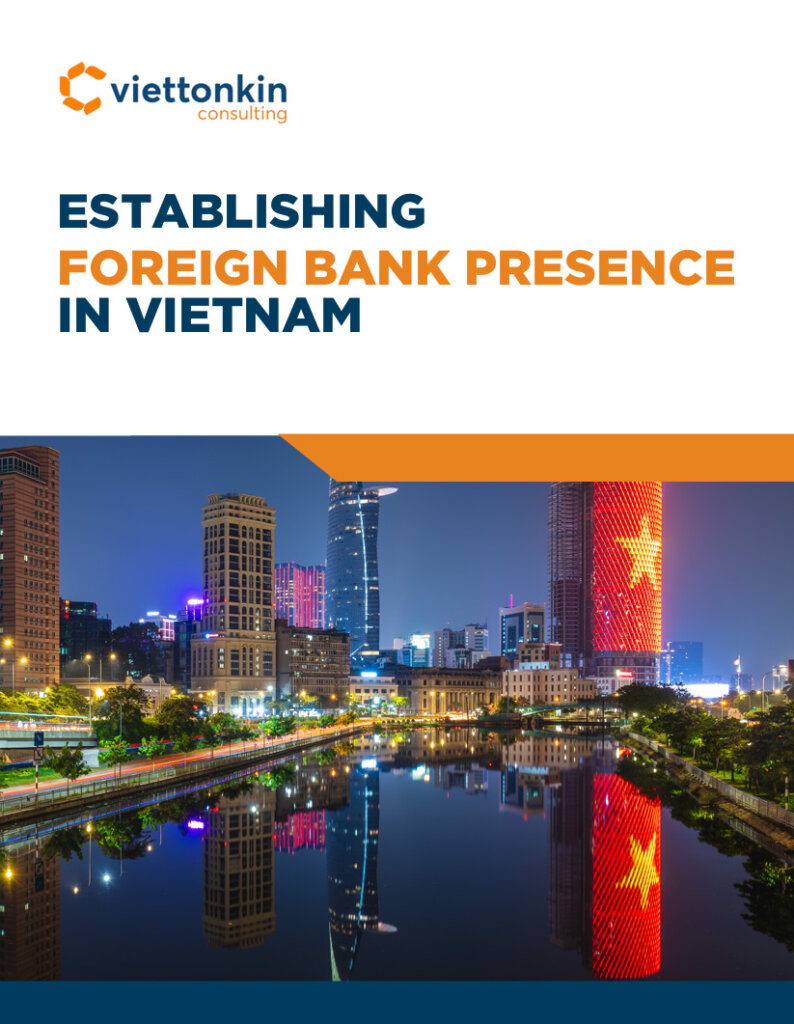
Entering Vietnam's Banking Market: Get Your Essential 2025 eBook
Vietnam's dynamic banking sector is a top destination for foreign investment. To succeed, you need a deep understanding of the local landscape, from new regulations to market entry models.
Our eBook, "ESTABLISHING FOREIGN BANK PRESENCE IN VIETNAM" gives you the crucial insights you need, including:
2024–2025 Sector Overview: Key economic and banking industry analysis.
Step-by-Step Entry Guidance: A deep dive into all primary market entry modes.
The Latest Legal Updates: Critical regulatory changes taking effect in 2025.
Smart Investment Strategies: Insights on M&A, strategic equity, and Fintech.
Download now for the expert knowledge to invest with confidence.
Entering Vietnam's Banking Market: Get Your Essential 2025 eBook
Vietnam's dynamic banking sector is a top destination for foreign investment. To succeed, you need a deep understanding of the local landscape, from new regulations to market entry models.
Our eBook, "ESTABLISHING FOREIGN BANK PRESENCE IN VIETNAM" gives you the crucial insights you need, including:
2024–2025 Sector Overview: Key economic and banking industry analysis.
Step-by-Step Entry Guidance: A deep dive into all primary market entry modes.
The Latest Legal Updates: Critical regulatory changes taking effect in 2025.
Smart Investment Strategies: Insights on M&A, strategic equity, and Fintech.
Download now for the expert knowledge to invest with confidence.
Founded in 2009, Viettonkin Consulting is a multi-disciplinary group of consulting firms headquartered in Hanoi, Vietnam with offices in Ho Chi Minh City, Jakarta, Bangkok, Singapore, and Hong Kong and a strong presence through strategic alliances throughout Southeast Asia. Our firm’s guiding mission is aimed towards facilitating intra-ASEAN investments and connecting investors in Southeast Asia with the rest of the world, thus promoting international business relationships and strengthening inter-nation connections.






 English